The Pitz–Daily Case as a Benchmark for Turbulence Model Assessment
DOI:
https://doi.org/10.63595/vetor.v36i2.20800Keywords:
Turbulence, Backward-facing step, Pitz–Daily, Computational Fluid Dynamics, ModelingAbstract
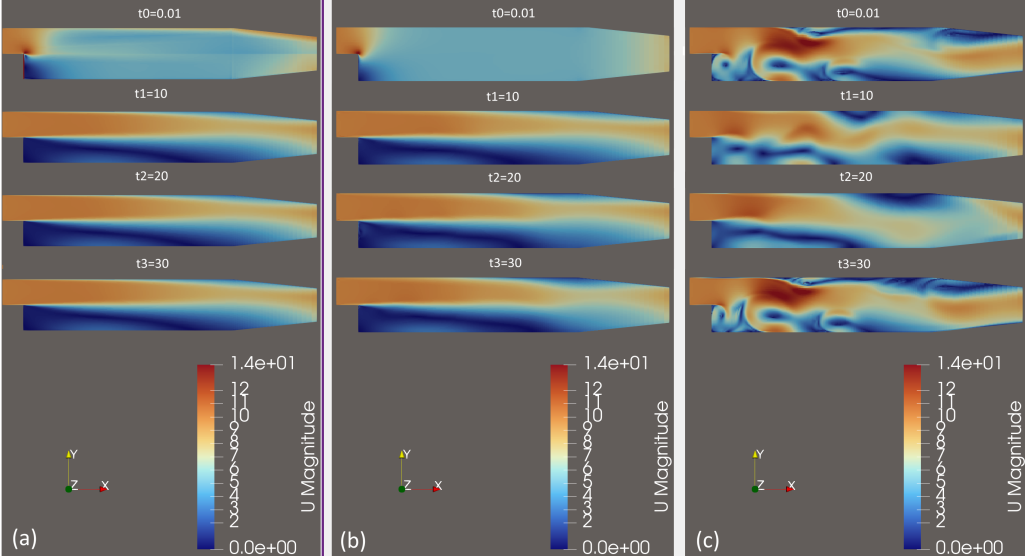
Turbulence modeling remains a major challenge in Computational Fluid Dynamics (CFD) and is often assessed through benchmark cases. In this work, the classical Pitz–Daily case, characterized by internal flow in a rectangular duct with a backward-facing step, was employed to evaluate Reynolds Average Navier-Stokes Equation (RANS) turbulence models. The simulations were performed using OpenFOAM, assuming incompressible and steady-state flow. To investigate the influence of the mesh on the results, a systematic analysis was carried out involving various levels of refinement, with particular attention to regions of higher flow complexity, such as the vicinity of the step, shear layers, and recirculation zones. This approach allowed evaluating the ability of different meshes to accurately capture the velocity and pressure fields, as well as the extent of recirculation regions and flow reattachment points. In addition, k-ε, k-ω and k-ωSST turbulence models were analyzed, along with different near-wall treatments under low Reynolds number conditions, specifically the Jones-Launder, Launder-Sharma, and Lam-Bremhorst models. The numerical results were compared with experimental data available in the literature, highlighting differences in the prediction of recirculation regions and velocity profiles. The findings emphasize the importance of an appropri ate choice of turbulence model and near-wall treatment, confirming the Pitz–Daily case as a relevant benchmark for CFD studies.
Downloads
References
D. C. Wilcox, Turbulence modeling for CFD, 3a ed. La Cãnada, Calif: DCW Industries, 2006.
P. A. C. Rocha, F. P. Marinho, V. O. Santos, S. P. Mendonça, e M. E. V. d. Silva, “Turbulence models applied to classical fluid mechanics and heat transfer problems: the perfomance evaluation of the open source CFD package OPENFOAM,” ACERTTE, vol. 1, no. 5, 2021. Disponível em: https://doi.org/10.47820/acertte.v1i5.39
R. W. Pitz e J. W. Daily, “Combustion in a turbulent mixing layer formed at a rearward-facing step,” AIAA Journal, vol. 21, no. 11, pp. 1565–1570, 1983. Disponível em: https://doi.org/10.2514/3.8290
R. Pitz e J. Daily, “Experimental study of combustion in a turbulent free shear layer formed at a rearward facing step,” em 19th Aerospace Sciences Meeting. AIAA, 1981, p. 106. Disponível em: https://doi.org/10.2514/6.1981-106
D. M. Driver e H. L. Seegmiller, “Features of a reattaching turbulent shear layer in divergent channelflow,” AIAA Journal, vol. 23, no. 2, pp. 163–171, 1985. Disponível em: https://doi.org/10.2514/3.8890
D. Agonafer, L. Gan-Li, e D. B. Spalding, “The LVEL turbulence model for conjugate heat transfer at low reynolds numbers,” em ASME International Mechanical Engineering Congress and Exposition, vol. 15533. American Society of Mechanical Engineers, 1996, pp. 23–26. Disponível em: https: //doi.org/10.1115/IMECE1996-0998
P. Spalart e S. Allmaras, “A one-equation turbulence model for aerodynamic flows,” em 30th Aerospace Sciences Meeting and Exhibit. AIAA, 1992, p. 439. Disponível em: https://doi.org/10.2514/6.1992-439
B. E. Launder e D. B. Spalding, “The numerical computation of turbulent flows,” em Numerical prediction of flow, heat transfer, turbulence and combustion. Elsevier, 1983, pp. 96–116.
C. G. Speziale, “On nonlinear K-l and K-ε models of turbulence,” Journal of Fluid Mechanics, vol. 178, pp. 459–475, 1987. Disponível em: https://doi.org/10.1017/S0022112087001319
J. H. Ferziger e M. Perić, Computational methods for fluid dynamics, 3a ed. Berlin ; New York: Springer, 2002.
H. K. Versteeg e W. Malalasekera, An introduction to computational fluid dynamics: the finite volume method, 2a ed. Harlow, England ; New York: Pearson Education Ltd, 2007, oCLC: ocm76821177.
OpenFOAM Foundation. Disponível em: turbulence/ras/linear-evm/rtm/kEpsilon/https://doc.openfoam.com/2306/tools/processing/models/
——. Disponível em: https://api.openfoam.com/2406/kOmega_8C_source.html
R. B. Bird, W. E. Stewart, e E. N. Lightfoot, Transport Phenomena, 2a ed. John Wiley & Sons, 2002.
S. T. Bose e G. I. Park, “Wall-modeled large-eddy simulation for complex turbulent flows,” Annual Review of Fluid Mechanics, vol. 50, pp. 535–561, 2018. Disponível em: https://doi.org/10.1146/annurev-fluid-122316-045241
T. Cebeci e A. Smith, “Analysis of turbulent boundary layers,” NASA STI/Recon Technical Report A, vol. 75, p. 46513, 1974.
B. Baldwin e H. Lomax, “Thin-layer approximation and algebraic model for separated turbulent flows,” em 16th Aerospace Sciences Meeting. AIAA, 1978, p. 257. Disponível em: https://doi.org/10.2514/6.1978-257
D. S.-K. Ting, “Wall turbulence,” em Basics of Engineering Turbulence, D. S.-K. Ting, Ed. Academic Press, 2016, cap. 6, pp. 119–138. Disponível em: https://doi.org/10.1016/B978-0-12-803970-0.00006-4
W. P. Jones e B. E. Launder, “The prediction of laminarization with a two-equation model of turbulence,” International Journal of Heat and Mass Transfer, vol. 15, no. 2, pp. 301–314, 1972. Disponível em: https://doi.org/10.1016/0017-9310(72)90076-2
B. E. Launder e B. I. Sharma, “Application of the energy-dissipation model of turbulence to the calculation of flow near a spinning disc,” Letters in Heat and Mass Transfer, vol. 1, no. 2, pp. 131–137, 1974. Disponível em: https://doi.org/10.1016/0094-4548(74)90150-7
C. Lam e K. Bremhorst, “A modified form of the k-ε model for predicting wall turbulence,” Journal of Fluids Engineering, vol. 103, no. 3, pp. 456–460, 1981. Disponível em: https://doi.org/10.1115/1.3240815
OpenFOAM Foundation, “Openfoam,” https://www.openfoam.com, 2024, version v2406.
——, “Steady turbulent flow over a backward-facing step,” https://www.openfoam.com/documentation/tutorialguide, 2023, openFOAM Documentation. Accessed online.
B. F. Armaly, F. Durst, J. C. F. Pereira, e B. Schonung, “Experimental and theoretical investigation of backward-facing step flow,” Journal of Fluid Mechanics, vol. 127, pp. 473–496, 1983. Disponível em: https://doi.org/10.1017/S0022112083002839
M. A. R. Silva, G. B. Corrêa, e J. F. Mitre, “Comparação entre modelos de turbulência do tipo rans por simulação de fluxo em um degrau,” em Proceedings of the Flow Turbulence and Combustion Symposium (FTSP), 2017.
P. A. Durbin, “Near-wall turbulence closure modeling without “damping functions”,” Theoretical and Computational Fluid Dynamics, vol. 3, no. 1, pp. 1–13, 1991. Disponível em: https://doi.org/10.1007/BF00271513
L. Chen, K. Asai, T. Nonomura, G. Xi, e T. Liu, “A review of backward-facing step (BFS) flow mechanisms, heat transfer and control,” Thermal Science and Engineering Progress, vol. 6, pp. 194–216, 2018. Disponível em: https://doi.org/10.1016/j.tsep.2018.04.004
Downloads
Published
How to Cite
Issue
Section