Simulação Numérica de Escoamentos Não Isotérmicos em Reservatórios de Shale Gas Considerando Aquecimento
DOI:
https://doi.org/10.63595/vetor.v36i1.20885Palavras-chave:
Adsorção, Escoamento não isotérmico, Simulação de reservatórios, Shale gas, EscorregamentoResumo
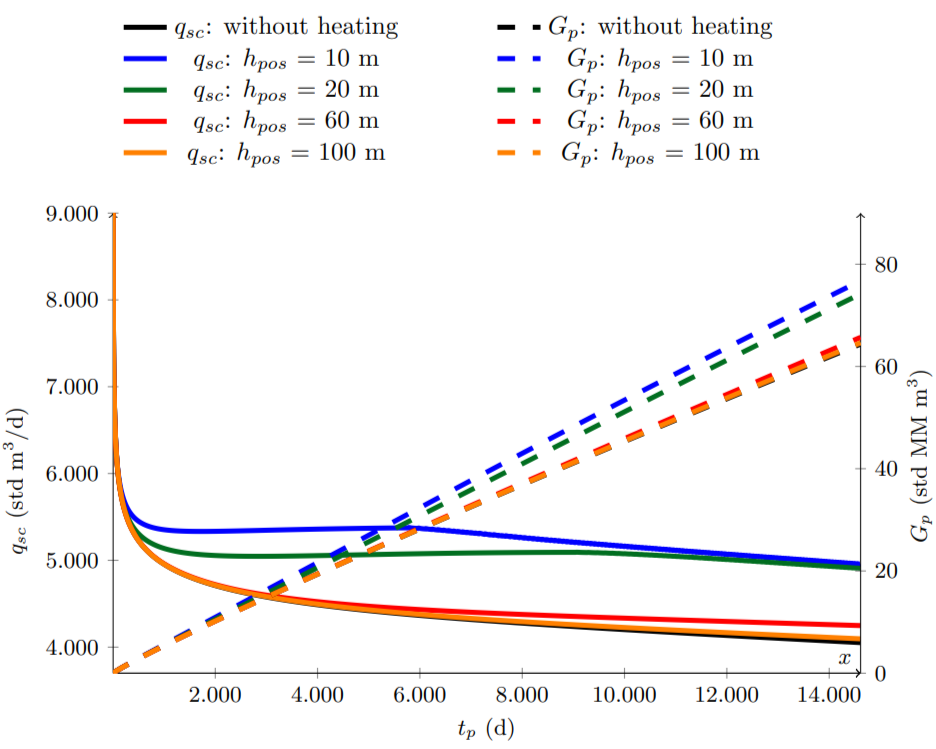
Este estudo aplica o Método dos Volumes Finitos para modelar o escoamento não isotérmico em reservatórios de gás de folhelho, considerando os efeitos de adsorção e escorregamento do gás. A análise concentra-se na recuperação avançada por meio do uso de aquecedores estáticos. O modelo proposto incorpora a permeabilidade absoluta dependente da temperatura, bem como a adsorção dependente da pressão e da temperatura. Uma formulação totalmente implícita é adotada, com linearização pelo método de Picard e solução dos sistemas resultantes por meio do método dos Gradientes Conjugados. Os resultados demonstram que a estimulação térmica melhora significativamente a produção de gás de folhelho. Em cenários de longo prazo, o uso de oito aquecedores aumentou a produção acumulada em até 24% em comparação com o caso sem aquecimento. Além disso, a análise de diferentes taxas de aquecimento revelou que o cenário de 80 kW apresenta o desempenho mais favorável, atingindo balanço energético positivo após aproximadamente 1900 dias e superando um ganho de eficiência de 30% ao longo de um período de 40 anos. Esses resultados destacam a importância dos efeitos térmicos, da adsorção e do escorregamento no escoamento não isotérmico de gás de folhelho, fornecendo insights valiosos para a otimização de estratégias de recuperação e para a melhoria da viabilidade econômica de métodos térmicos.
Downloads
Referências
[1] United Nations, “World Population Prospects 2022: Summary of Results,” United Nations, Tech. Rep., 2022. Available at: https://www.un.org/development/desa/pd/content/World-Population-Prospects-2022
[2] US Environmental Protection Agency, “GHGRP 2021: Petroleum and Natural Gas Systems,” United States Environmental Protection Agency, Tech. Rep., 2021. Available at: https://www.epa.gov/ghgreporting/ghgrp-2021-petroleum-and-natural-gas-systems
[3] United Nations, “World Urbanization Prospects 2025,” United Nations, Department of Economic and Social Affairs, Population Division, Tech. Rep., 2025. Available at: https://population.un.org/wup/
[4] International Energy Agency, “CCUS in Clean Energy Transitions,” International Energy Agency, Energy Technology Perspectives, Tech. Rep., 2020. Available at: https://www.iea.org/reports/ccus-in-clean-energy-transitions
[5] U.S. Energy Information Administration, “Annual Energy Outlook 2020,” U.S. Energy Information Administration, Tech. Rep., 2020. Available at: https://www.eia.gov/outlooks/aeo/section_issue_policies.php
[6] K. K. Chong, W. V. Grieser, A. Passman, C. H. Tamayo, N. Modeland, and B. Burke, “A completions guide book to shale-play development: A review of successful approaches towards shale-play stimulation in the last two decades,” in Canadian Unconventional Resources and International Petroleum Conference, Calgary, Alberta, Canada, 2010, pp. SPE–133 874–MS. Available at: https://doi.org/10.2118/133874-MS
[7] T. Euzen, “Shale Gas — An Overview,” IFP Technologies (Canada) Inc., Tech. Rep., 2011. Available at: https://ifp-canada.com/wp-content/uploads/2014/01/IFP_Canada_Shale_Gas_Report.pdf
[8] R. Strickland, D. Purvis, and T. Blasingame, “Practical aspects of reserve determinations for shale gas,” in North American Unconventional Gas Conference and Exhibition, The Woodlands, Texas, USA, 2011, pp. SPE–144 357–MS. Available at: https://doi.org/10.2118/144357-MS
[9] M. Lu, Z. Pan, L. D. Connell, and Y. Lu, “A coupled, non-isothermal gas shale flow model: Application to evaluation of gas-in-place in shale with core samples,” Journal of Petroleum Science and Engineering, vol. 158, pp. 361–379, 2017. Available at: https://doi.org/10.1016/j.petrol.2017.08.051
[10] F. A. Florence, J. A. Rushing, K. E. Newsham, and T. A. Blasingame, “Improved permeability prediction relations for low-permeability sands,” in Rocky Mountain Oil & Gas Technology Symposium, Denver, Colorado, USA, 2007, pp. SPE–107 954–MS. Available at: https://doi.org/10.2118/107954-MS
[11] F. Civan, “Effective correlation of apparent gas permeability in tight porous media,” Transport in Porous Media, vol. 82, no. 2, pp. 375–384, 2010. Available at: https://doi.org/10.1007/s11242-009-9432-z
[12] A. A. Moghadam and R. Chalaturnyk, “Expansion of the Klinkenberg’s slippage equation to low permeability porous media,” International Journal of Coal Geology, vol. 123, pp. 2–9, 2014. Available at: https://doi.org/10.1016/j.coal.2013.10.008
[13] F. Aminzadeh, “Hydraulic fracturing, an overview,” Journal of Sustainable Energy Engineering, vol. 6, no. 3, pp. 204–228, 2018. Available at: https://doi.org/10.7569/jsee.2018.629512
[14] J. Taskinsoy, “Economic & ecological implications of hydraulic fracturing,” West East Journal of Social Sciences, vol. 2, no. 1, pp. 11–39, 2013. Available at: https://www.westeastinstitute.com/journals/wp-content/uploads/2013/04/2-John-Taskinsoy-Second-paper-Ready.pdf
[15] L. Xue, C. Dai, L. Wang, and X. Chen, “Analysis of thermal stimulation to enhance shale gas recovery through a novel conceptual model,” Geofluids, vol. 2019, no. 1, p. 4084356, 2019. Available at: https://doi.org/10.1155/2019/4084356
[16] J.-Y. Yuan, E. E. Isaacs, H. Huang, and D. G. Vandenhoff, “Wet Electric Heating Process,” Patent US6 631 761B2, 2003. Available at: https://patents.google.com/patent/US6631761B2/en
[17] J. Liu, Y. Xue, Y. Fu, K. Yao, and J. Liu, “Numerical investigation on microwave-thermal recovery of shale gas based on a fully coupled electromagnetic, heat transfer, and multiphase flow model,” Energy, vol. 263, p. 126090, 2023. Available at: https://doi.org/10.1016/j.energy.2022.126090
[18] A. K. M. Jamaluddin, D. B. Bennion, F. B. Thomas, and T. Y. Ma, “Application of heat treatment to enhance permeability in tight gas reservoirs,” Journal of Canadian Petroleum Technology, vol. 39, no. 11, 2000. Available at: https://doi.org/10.2118/00-11-01
[19] G. Chapiro and J. Bruining, “Combustion enhance recovery of shale gas,” Journal of Petroleum Science and Engineering, vol. 127, pp. 179–189, 2015. Available at: https://doi.org/10.1016/j.petrol.2015.01.036
[20] L. B. Lima, “Simulação numérica de escoamentos não-isotérmicos em reservatórios do tipo shale gas,” Master’s thesis, Instituto Politécnico, Universidade do Estado do Rio de Janeiro, Nova Friburgo, RJ, Brasil, 2023. Available at: https://www.bdtd.uerj.br/handle/1/21675
[21] T. Ertekin, J. H. Abou-Kassem, and G. R. King, Basic Applied Reservoir Simulation. Richardson, USA: Society of Petroleum Engineers, 2001.
[22] J. D. S. Heringer, “Simulação numérica de escoamento tridimensional não-isotérmico em reservatórios de petróleo,” Master’s thesis, Instituto Politécnico, Universidade do Estado do Rio de Janeiro, Nova Friburgo, RJ, Brasil, 2018. Available at: https://www.bdtd.uerj.br/handle/1/13842
[23] C. Moyne, S. Didierjean, H. P. Amaral Souto, and O. T. da Silveira, “Thermal dispersion in porous media: one-equation model,” International Journal of Heat and Mass Transfer, vol. 43, no. 20, pp. 3853–3867, 2000. Available at: https://doi.org/10.1016/S0017-9310(00)00021-1
[24] M. Quintard and S. Whitaker, “Local thermal equilibrium for transient heat conduction: theory and comparison with numerical experiments,” International Journal of Heat and Mass Transfer, vol. 38, no. 15, pp. 2779–2796, 1995. Available at: https://doi.org/10.1016/0017-9310(95)00028-8
[25] D. W. Peaceman, “Interpretation of well-block pressures in numerical reservoir simulation,” Society of Petroleum Engineers Journal, vol. 18, no. 3, pp. 183–194, 1978. Available at: https://doi.org/10.2118/6893-PA
[26] H. K. Versteeg and W. Malalasekera, An Introduction to Computational Fluid Dynamics: The Finite Volume Method, 2nd ed. Harlow, England: Pearson Education, 2007.
[27] Z. Chen, G. Huan, and Y. Ma, Computational Methods for Multiphase Flows in Porous Media. Philadelphia, PA, USA: Society for Industrial and Applied Mathematics, 2006. Available at: https://doi.org/10.1137/1.9780898718942
[28] R. L. Burden and J. D. Faires, Numerical Analysis, 9th ed. Boston, MA, USA: Brooks/Cole, Cengage Learning, 2011.
[29] D. W. Peaceman, “Interpretation of well-block pressures in numerical reservoir simulation with nonsquare grid blocks and anisotropic permeability,” Society of Petroleum Engineers Journal, vol. 23, no. 3, pp. 531–543, 1983. Available at: https://doi.org/10.2118/10528-PA
[30] J. G. S. Debossam, M. M. de Freitas, G. de Souza, and H. P. Amaral Souto, “Numerical simulation of three-phase flow in petroleum reservoirs using a Picard–Newton sequential method,” Journal of the Brazilian Society of Mechanical Sciences and Engineering, vol. 47, no. 7, p. 347, 2025. Available at: https://doi.org/10.1007/s40430-025-05658-y
Downloads
Publicado
Como Citar
Edição
Seção