Numerical Simulation of Non-Isothermal Flows in Shale Gas Reservoirs Considering Heating
DOI:
https://doi.org/10.63595/vetor.v36i1.20885Keywords:
Adsorption, Non-isothermal flow, Reservoir simulation, Shale gas, SlippageAbstract
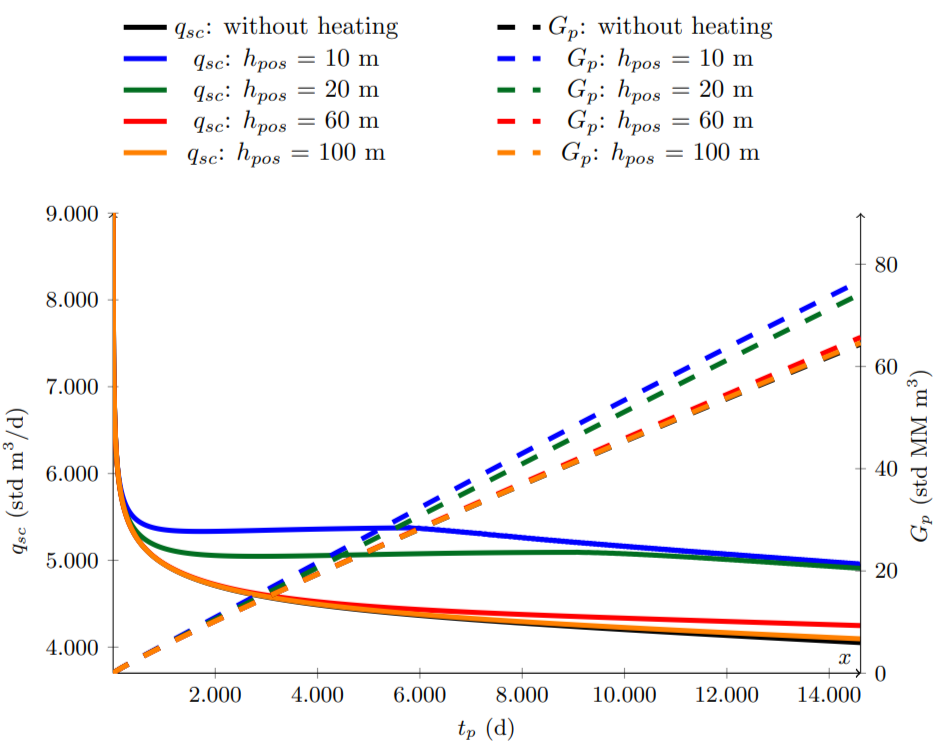
This study applies the Finite Volume Method to model non-isothermal flow in shale gas reservoirs, accounting for adsorption and gas slippage effects. The analysis focuses on enhanced recovery through the use of static heaters. The proposed model incorporates temperature-dependent absolute permeability and pressure- and temperature-dependent adsorption. A fully implicit formulation is adopted, with linearization via the Picard method and solution of the resulting systems using the Conjugate Gradient method. The results demonstrate that thermal stimulation significantly improves shale gas production. In long-term scenarios, the use of eight heaters increased cumulative production by up to 24% compared to the case without heating. Additionally, the analysis of different heating rates revealed that the 80 kW scenario provides the most favorable performance, achieving a positive energy balance after approximately 1900 days and exceeding 30% efficiency gain over a 40-year period. These findings highlight the importance of thermal effects, adsorption, and slippage in non-isothermal shale gas flow, providing valuable insights for optimizing recovery strategies and improving the economic viability of thermal methods.
Downloads
References
[1] United Nations, “World Population Prospects 2022: Summary of Results,” United Nations, Tech. Rep., 2022. Available at: https://www.un.org/development/desa/pd/content/World-Population-Prospects-2022
[2] US Environmental Protection Agency, “GHGRP 2021: Petroleum and Natural Gas Systems,” United States Environmental Protection Agency, Tech. Rep., 2021. Available at: https://www.epa.gov/ghgreporting/ghgrp-2021-petroleum-and-natural-gas-systems
[3] United Nations, “World Urbanization Prospects 2025,” United Nations, Department of Economic and Social Affairs, Population Division, Tech. Rep., 2025. Available at: https://population.un.org/wup/
[4] International Energy Agency, “CCUS in Clean Energy Transitions,” International Energy Agency, Energy Technology Perspectives, Tech. Rep., 2020. Available at: https://www.iea.org/reports/ccus-in-clean-energy-transitions
[5] U.S. Energy Information Administration, “Annual Energy Outlook 2020,” U.S. Energy Information Administration, Tech. Rep., 2020. Available at: https://www.eia.gov/outlooks/aeo/section_issue_policies.php
[6] K. K. Chong, W. V. Grieser, A. Passman, C. H. Tamayo, N. Modeland, and B. Burke, “A completions guide book to shale-play development: A review of successful approaches towards shale-play stimulation in the last two decades,” in Canadian Unconventional Resources and International Petroleum Conference, Calgary, Alberta, Canada, 2010, pp. SPE–133 874–MS. Available at: https://doi.org/10.2118/133874-MS
[7] T. Euzen, “Shale Gas — An Overview,” IFP Technologies (Canada) Inc., Tech. Rep., 2011. Available at: https://ifp-canada.com/wp-content/uploads/2014/01/IFP_Canada_Shale_Gas_Report.pdf
[8] R. Strickland, D. Purvis, and T. Blasingame, “Practical aspects of reserve determinations for shale gas,” in North American Unconventional Gas Conference and Exhibition, The Woodlands, Texas, USA, 2011, pp. SPE–144 357–MS. Available at: https://doi.org/10.2118/144357-MS
[9] M. Lu, Z. Pan, L. D. Connell, and Y. Lu, “A coupled, non-isothermal gas shale flow model: Application to evaluation of gas-in-place in shale with core samples,” Journal of Petroleum Science and Engineering, vol. 158, pp. 361–379, 2017. Available at: https://doi.org/10.1016/j.petrol.2017.08.051
[10] F. A. Florence, J. A. Rushing, K. E. Newsham, and T. A. Blasingame, “Improved permeability prediction relations for low-permeability sands,” in Rocky Mountain Oil & Gas Technology Symposium, Denver, Colorado, USA, 2007, pp. SPE–107 954–MS. Available at: https://doi.org/10.2118/107954-MS
[11] F. Civan, “Effective correlation of apparent gas permeability in tight porous media,” Transport in Porous Media, vol. 82, no. 2, pp. 375–384, 2010. Available at: https://doi.org/10.1007/s11242-009-9432-z
[12] A. A. Moghadam and R. Chalaturnyk, “Expansion of the Klinkenberg’s slippage equation to low permeability porous media,” International Journal of Coal Geology, vol. 123, pp. 2–9, 2014. Available at: https://doi.org/10.1016/j.coal.2013.10.008
[13] F. Aminzadeh, “Hydraulic fracturing, an overview,” Journal of Sustainable Energy Engineering, vol. 6, no. 3, pp. 204–228, 2018. Available at: https://doi.org/10.7569/jsee.2018.629512
[14] J. Taskinsoy, “Economic & ecological implications of hydraulic fracturing,” West East Journal of Social Sciences, vol. 2, no. 1, pp. 11–39, 2013. Available at: https://www.westeastinstitute.com/journals/wp-content/uploads/2013/04/2-John-Taskinsoy-Second-paper-Ready.pdf
[15] L. Xue, C. Dai, L. Wang, and X. Chen, “Analysis of thermal stimulation to enhance shale gas recovery through a novel conceptual model,” Geofluids, vol. 2019, no. 1, p. 4084356, 2019. Available at: https://doi.org/10.1155/2019/4084356
[16] J.-Y. Yuan, E. E. Isaacs, H. Huang, and D. G. Vandenhoff, “Wet Electric Heating Process,” Patent US6 631 761B2, 2003. Available at: https://patents.google.com/patent/US6631761B2/en
[17] J. Liu, Y. Xue, Y. Fu, K. Yao, and J. Liu, “Numerical investigation on microwave-thermal recovery of shale gas based on a fully coupled electromagnetic, heat transfer, and multiphase flow model,” Energy, vol. 263, p. 126090, 2023. Available at: https://doi.org/10.1016/j.energy.2022.126090
[18] A. K. M. Jamaluddin, D. B. Bennion, F. B. Thomas, and T. Y. Ma, “Application of heat treatment to enhance permeability in tight gas reservoirs,” Journal of Canadian Petroleum Technology, vol. 39, no. 11, 2000. Available at: https://doi.org/10.2118/00-11-01
[19] G. Chapiro and J. Bruining, “Combustion enhance recovery of shale gas,” Journal of Petroleum Science and Engineering, vol. 127, pp. 179–189, 2015. Available at: https://doi.org/10.1016/j.petrol.2015.01.036
[20] L. B. Lima, “Simulação numérica de escoamentos não-isotérmicos em reservatórios do tipo shale gas,” Master’s thesis, Instituto Politécnico, Universidade do Estado do Rio de Janeiro, Nova Friburgo, RJ, Brasil, 2023. Available at: https://www.bdtd.uerj.br/handle/1/21675
[21] T. Ertekin, J. H. Abou-Kassem, and G. R. King, Basic Applied Reservoir Simulation. Richardson, USA: Society of Petroleum Engineers, 2001.
[22] J. D. S. Heringer, “Simulação numérica de escoamento tridimensional não-isotérmico em reservatórios de petróleo,” Master’s thesis, Instituto Politécnico, Universidade do Estado do Rio de Janeiro, Nova Friburgo, RJ, Brasil, 2018. Available at: https://www.bdtd.uerj.br/handle/1/13842
[23] C. Moyne, S. Didierjean, H. P. Amaral Souto, and O. T. da Silveira, “Thermal dispersion in porous media: one-equation model,” International Journal of Heat and Mass Transfer, vol. 43, no. 20, pp. 3853–3867, 2000. Available at: https://doi.org/10.1016/S0017-9310(00)00021-1
[24] M. Quintard and S. Whitaker, “Local thermal equilibrium for transient heat conduction: theory and comparison with numerical experiments,” International Journal of Heat and Mass Transfer, vol. 38, no. 15, pp. 2779–2796, 1995. Available at: https://doi.org/10.1016/0017-9310(95)00028-8
[25] D. W. Peaceman, “Interpretation of well-block pressures in numerical reservoir simulation,” Society of Petroleum Engineers Journal, vol. 18, no. 3, pp. 183–194, 1978. Available at: https://doi.org/10.2118/6893-PA
[26] H. K. Versteeg and W. Malalasekera, An Introduction to Computational Fluid Dynamics: The Finite Volume Method, 2nd ed. Harlow, England: Pearson Education, 2007.
[27] Z. Chen, G. Huan, and Y. Ma, Computational Methods for Multiphase Flows in Porous Media. Philadelphia, PA, USA: Society for Industrial and Applied Mathematics, 2006. Available at: https://doi.org/10.1137/1.9780898718942
[28] R. L. Burden and J. D. Faires, Numerical Analysis, 9th ed. Boston, MA, USA: Brooks/Cole, Cengage Learning, 2011.
[29] D. W. Peaceman, “Interpretation of well-block pressures in numerical reservoir simulation with nonsquare grid blocks and anisotropic permeability,” Society of Petroleum Engineers Journal, vol. 23, no. 3, pp. 531–543, 1983. Available at: https://doi.org/10.2118/10528-PA
[30] J. G. S. Debossam, M. M. de Freitas, G. de Souza, and H. P. Amaral Souto, “Numerical simulation of three-phase flow in petroleum reservoirs using a Picard–Newton sequential method,” Journal of the Brazilian Society of Mechanical Sciences and Engineering, vol. 47, no. 7, p. 347, 2025. Available at: https://doi.org/10.1007/s40430-025-05658-y
Downloads
Published
How to Cite
Issue
Section