Decentralized versus Centralized COVID‑19 Interventions in Mozambique: A Metapopulation Modeling Study
DOI:
https://doi.org/10.63595/vetor.v36i1.20939Keywords:
COVID-19, Mozambique, Decentralized interventions, Metapopulation modeling, Nonpharmaceutical interventionsAbstract
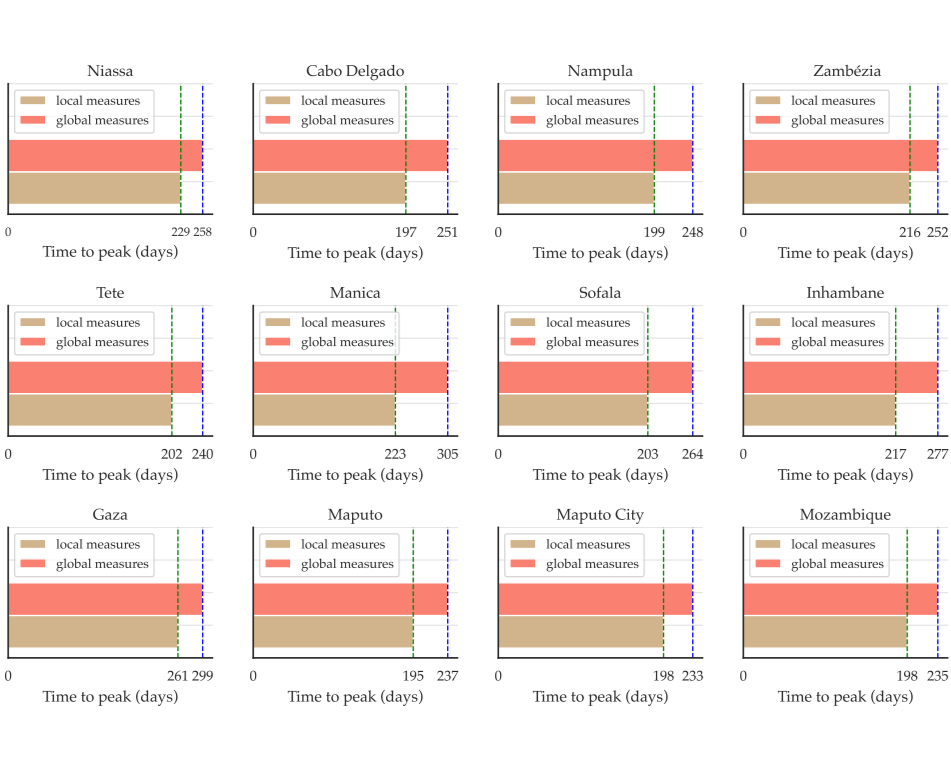
Country-wide lockdowns often face resistance when perceived as overly broad or misaligned with local realities. Designing effective, context-sensitive interventions requires understanding whether centralized national or decentralized provincial measures are more appropriate. This study extends previous analyses by developing a stochastic metapopulation model to simulate COVID-19 transmission across Mozambique’s 11 provinces during the first epidemic wave from March 22, 2020 to March 7, 2021. Human mobility was modeled via a radiation-based transition matrix, and the model was calibrated using effective population estimates and reported active cases. Three core intervention scenarios were evaluated including mobility without interventions, mobility with centralized national-triggered interventions, and mobility with decentralized province-specific triggers. Additional simulations assessed the robustness of interventions under varying physical distancing effectiveness ε, national thresholds νG, and provincial thresholds νL. Results indicate that decentralized interventions outperformed centralized approaches, delaying provincial epidemic peaks by 29 to 82 days, with a national average of 37 days, and reducing cumulative infections by 0.74-6.86% across provinces, with a national reduction greater than 2.49%. Sensitivity analyses show that higher physical distancing effectiveness and stricter local thresholds further delay peaks, particularly in less-connected provinces. Global sensitivity analysis highlights transmission rate, interprovincial connectivity, and intervention efficacy as the most influential factors. These findings suggest that province-specific strategies provide a superior balance between epidemic control and socioeconomic resilience in resource-limited settings and demonstrate the importance of spatially explicit mobility-aware models to guide adaptive public health policies and future pandemic preparedness under heterogeneous regional conditions.
Downloads
References
[1] C. T. Bauch, J. O. Lloyd-Smith, M. P. Coffee, and A. P. Galvani, “Dynamically modeling SARS and other newly emerging respiratory illnesses: Past, present, and future,” Epidemiology, vol. 16, no. 6, pp. 791–801, 2005. Available at: https://doi.org/10.1097/01.ede.0000181633.80269.4c
[2] I. M. Longini, A. Nizam, S. Xu, K. Ungchusak, W. Hanshaoworakul, D. A. T. Cummings, and M. E. Halloran, “Containing pandemic influenza at the source,” Science, vol. 309, no. 5737, pp. 1083–1087, 2005. Available at: https://doi.org/10.1126/science.1115717
[3] A. Aleta, D. Martín-Corral, A. Pastore y Piontti, M. Ajelli, M. Litvinova, M. Chinazzi, N. E. Dean, M. E. Halloran, I. M. Longini Jr, S. Merler, A. Pentland, A. Vespignani, E. Moro, and Y. Moreno, “Modelling the impact of testing, contact tracing and household quarantine on second waves of COVID-19,” Nature Human Behaviour, vol. 4, no. 9, pp. 964–971, 2020. Available at: https://doi.org/10.1038/s41562-020-0931-9
[4] S. Y. D. Valle, S. M. Mniszewski, and J. M. Hyman, Modeling the Impact of Behavior Changes on the Spread of Pandemic Influenza. New York, NY: Springer New York, 2013, pp. 59–77. Available at: https://doi.org/10.1007/978-1-4614-5474-8_4
[5] S. C. Anderson, A. M. Edwards, M. Yerlanov, N. Mulberry, J. E. Stockdale, S. A. Iyaniwura, R. C. Falcao, M. C. Otterstatter, M. A. Irvine, N. Z. Janjua, D. Coombs, and C. Colijn, “Quantifying the impact of COVID-19 control measures using a Bayesian model of physical distancing,” PLOS Computational Biology, vol. 16, no. 12, pp. 1–15, 2020. Available at: https://doi.org/10.1371/journal.pcbi.1008274
[6] A. de Souza Melo, A. I. G. da Penha Sobral, M. L. M. Marinho, G. B. Duarte, A. A. Vieira, and M. F. F. Sobral, “The impact of social distancing on COVID-19 infections and deaths,” Tropical Diseases, Travel Medicine and Vaccines, vol. 7, no. 1, p. 12, 2021. Available at: https://doi.org/10.1186/s40794-021-00137-3
[7] A. Brodeur, A. E. Clark, S. Flèche, and N. Powdthavee, “COVID-19, lockdowns and well-being: Evidence from Google trends,” IZA Network @ LISER, IZA Discussion Papers 13204, 2020. Available at: https://ideas.repec.org/p/iza/izadps/dp13204.html
[8] N. Haider, A. Y. Osman, A. Gadzekpo, G. O. Akipede, D. Asogun, R. Ansumana, R. J. Lessells, P. Khan, M. M. A. Hamid, D. Yeboah-Manu, L. Mboera, E. H. Shayo, B. T. Mmbaga, M. Urassa, D. Musoke, N. Kapata, R. A. Ferrand, P.-C. Kapata, F. Stigler, T. Czypionka, A. Zumla, R. Kock, and D. McCoy, “Lockdown measures in response to COVID-19 in nine sub-Saharan African countries,” BMJ Global Health, vol. 5, no. 10, p. e003319, 2020. Available at: https://doi.org/10.1136/bmjgh-2020-003319
[9] Conselho de Ministros, “Decreto presidencial nº 11/2020 de 30 de março: Declara o estado de emergência por razões de calamidade pública em todo o território nacional,” Boletim da República, I Série, n. 61, p. 325-326, Maputo, Moçambique, 2020.
[10] Agência Lusa, “Covid-19. Medidas atempadas e apoios permitiram controlar epidemia em Moçambique, diz a OMS,” 2020, Observador. Available at: https://observador.pt/2020/11/17/covid-19-medidas-atempadas-e-apoios-permitiram-controlar-epidemia-em-mocambique-diz-a-oms/
[11] L. E. G. Mboera, G. O. Akipede, A. Banerjee, L. E. Cuevas, T. Czypionka, M. Khan, R. Kock, D. McCoy, B. T. Mmbaga, G. Misinzo, E. H. Shayo, M. Sheel, C. Sindato, and M. Urassa, “Mitigating lockdown challenges in response to COVID-19 in Sub-Saharan Africa,” International Journal of Infectious Diseases, vol. 96, pp. 308–310, 2020. Available at: https://doi.org/10.1016/j.ijid.2020.05.018
[12] D. M. Julião and P. C. C. Cambrão, “Effects of lockdown policies for COVID-19 in Mozambique: Reflecting on perceptions about the effects of pandemic containment policies,” 2021, Collateral Global. Available at: https://collateralglobal.org/article/effects-of-lockdown-policies-for-covid-19-in-mozambique/
[13] G. Barletta, F. Castigo, E.-M. Egger, M. Keller, V. Salvucci, and F. Tarp, “The impact of COVID-19 on consumption poverty in Mozambique,” Journal of International Development, vol. 34, no. 4, pp. 771–802, 2022. Available at: https://doi.org/10.1002/jid.3599
[14] R. Betho, M. Chelengo, S. Jones, M. Keller, I. H. Mussagy, D. van Seventer, and F. Tarp, “The macroeconomic impact of COVID-19 in Mozambique: A social accounting matrix approach,” Journal of International Development, vol. 34, no. 4, pp. 823–860, 2022. Available at: https://doi.org/10.1002/jid.3601
[15] A. Sheikh, A. Sheikh, Z. Sheikh, and S. Dhami, “Reopening schools after the COVID-19 lockdown,” Journal of Global Health, vol. 10, no. 1, p. 010376, 2020. Available at: https://doi.org/10.7189/jogh.10.010376
[16] R. O. Macalinao, J. C. Malaguit, and D. S. Lutero, “Agent-based modeling of COVID-19 transmission in philippine classrooms,” Frontiers in Applied Mathematics and Statistics, vol. 8, p. 886082, 2022. Available at: https://doi.org/10.3389/fams.2022.886082
[17] Y. Li, E. A. Undurraga, and J. R. Zubizarreta, “Effectiveness of localized lockdowns in the COVID-19 pandemic,” American Journal of Epidemiology, vol. 191, no. 5, pp. 812–824, 2022. Available at: https://doi.org/10.1093/aje/kwac008
[18] D. O’Sullivan, M. Gahegan, D. J. Exeter, and B. Adams, “Spatially explicit models for exploring COVID-19 lockdown strategies,” Transactions in GIS, vol. 24, no. 4, pp. 967–1000, 2020. Available at: https://doi.org/10.1111/tgis.12660
[19] J. M. Amoedo, Y. Atrio-Lema, M. d. C. Sánchez-Carreira, and I. Neira, “The heterogeneous regional effect of mobility on Coronavirus spread,” The European Physical Journal Special Topics, vol. 231, no. 18, pp. 3391–3402, 2022. Available at: https://doi.org/10.1140/epjs/s11734-022-00533-6
[20] P. Coletti, P. Libin, O. Petrof, L. Willem, S. Abrams, S. A. Herzog, C. Faes, E. Kuylen, J. Wambua, P. Beutels, and N. Hens, “A data-driven metapopulation model for the Belgian COVID-19 epidemic: assessing the impact of lockdown and exit strategies,” BMC Infectious Diseases, vol. 21, no. 1, p. 503, 2021. Available at: https://doi.org/10.1186/s12879-021-06092-w
[21] Y. Li, L. Yu, X. Yang, T. Zhang, G. Sun, J. Lv, and Q.-H. Liu, “When mobility matters: How inter-regional travel shapes the effectiveness of local epidemic interventions,” Chaos, Solitons & Fractals, vol. 200, p. 117001, 2025. Available at: https://doi.org/10.1016/j.chaos.2025.117001
[22] Q. Shao and D. Han, “Epidemic spreading in metapopulation networks with heterogeneous mobility rates,” Applied Mathematics and Computation, vol. 412, p. 126559, 2022. Available at: https://doi.org/10.1016/j.amc.2021.126559
[23] P. Joaquim, D. Takahashi, and S. A. Pedro, “Understanding the role of human inter-provincial mobility on COVID-19 spread: a stochastic meta population model with time-dependent contact rates,” VETOR - Journal of Exact Sciences and Engineering, vol. 35, no. 1, p. e18479, 2025. Available at: https://doi.org/10.63595/vetor.v35i1.18479
[24] P. Joaquim, D. Takahashi, and S. Pedro, “The role of interprovincial mobility in the dynamics of COVID-19 epidemic in Mozambique: Insights from a stochastic metapopulation model,” in Anais do Encontro Nacional de Modelagem Computacional e Encontro de Ciência e Tecnologia de Materiais, Ilhéus, Brasil, 2024.
[25] V. A. Karatayev, M. Anand, and C. T. Bauch, “Local lockdowns outperform global lockdown on the far side of the COVID-19 epidemic curve,” Proceedings of the National Academy of Sciences, vol. 117, no. 39, pp. 24 575–24 580, 2020. Available at: https://doi.org/10.1073/pnas.2014385117
[26] Instituto Nacional de Estatística, “Anuário estatístico 2020 – Moçambique,” Instituto Nacional de Estatística, Maputo, Moçambique, Tech. Rep., 2021. Available at: https://ine.gov.mz/web/guest/d/anuario-2020_final
[27] O. Lisboa, “Covid-19 afecta empresas em Moçambique,” 2021, RFI. Available at: https://www.rfi.fr/pt/mo%C3%A7ambique/20200410-covid-19-afecta-empresas-em-mo%C3%A7ambique
[28] Ministério da Ciência, Tecnologias e Ensino Superior, “Estatísticas e indicadores do ensino superior em Moçambique – 2020,” Ministério de Ciência, Tecnologias e Ensino Superior, Maputo, Moçambique, Tech. Rep., 2023.
[29] A. Cassy, T. Marrufo, and S. Chicumbe, “COVID-19 em Moçambique: Relatório do 1º ano 2020-2021,” Instituto Nacional de Saúde, Observatório Nacional de Saúde, Marracuene, Moçambique, Tech. Rep., 2021. Available at: https://ons.gov.mz/wp-content/uploads/2022/06/ONS-Relatorio-do-1o-Ano-da-COVID-19-Mocambique.pdf
[30] Ministério da Saúde de Moçambique, “COVID-19 boletins diários,” Portal oficial do Ministério da Saúde, 2020.
[31] H. P. Duerr, S. O. Brockmann, I. Piechotowski, M. Schwehm, and M. Eichner, “Influenza pandemic intervention planning using InfluSim: pharmaceutical and non- pharmaceutical interventions,” BMC Infectious Diseases, vol. 7, no. 1, p. 76, 2007. Available at: https://doi.org/10.1186/1471-2334-7-76
[32] D. H. Morris, F. W. Rossine, J. B. Plotkin, and S. A. Levin, “Optimal, near-optimal, and robust epidemic control,” Communications Physics, vol. 4, no. 1, p. 78, 2021. Available at: https://doi.org/10.1038/s42005-021-00570-y
[33] A. Saltelli, P. Annoni, I. Azzini, F. Campolongo, M. Ratto, and S. Tarantola, “Variance based sensitivity analysis of model output. design and estimator for the total sensitivity index,” Computer Physics Communications, vol. 181, no. 2, pp. 259–270, 2010. Available at: https://doi.org/10.1016/j.cpc.2009.09.018
[34] M. Lamboni, “Uncertainty quantification: a minimum variance unbiased (joint) estimator of the non-normalized Sobol’ indices,” Statistical Papers, vol. 61, no. 5, pp. 1939–1970, 2020. Available at: https://doi.org/10.1007/s00362-018-1010-4
[35] I. M. Sobol, “Global sensitivity indices for nonlinear mathematical models and their Monte Carlo estimates,” Mathematics and Computers in Simulation, vol. 55, no. 1-3, pp. 271–280, 2001. Available at: https://doi.org/10.1016/S0378-4754(00)00270-6
[36] J. Herman and W. Usher, “SALib: An open-source Python library for sensitivity analysis,” Journal of Open Source Software, vol. 2, no. 9, p. 97, 2017. Available at: https://doi.org/10.21105/joss.00097
[37] P. Joaquim, D. Takahashi, and S. Pedro, “Policy impacts of lockdown strategies in Mozambique: Insights from a mobility-based stochastic COVID-19 model,” in Anais do Encontro Nacional de Modelagem Computacional e Encontro de Ciência e Tecnologia de Materiais, Montes Claros, Brasil, 2025.
[38] A. Topirceanu, M. Udrescu, and R. Marculescu, “Centralized and decentralized isolation strategies and their impact on the COVID-19 pandemic dynamics,” arXiv:2004.04222, 2020. Available at: https://doi.org/10.48550/arXiv.2004.04222
[39] L. J. Thomas, P. Huang, F. Yin, X. I. Luo, Z. W. Almquist, J. R. Hipp, and C. T. Butts, “Spatial heterogeneity can lead to substantial local variations in COVID-19 timing and severity,” Proceedings of the National Academy of Sciences, vol. 117, no. 39, pp. 24 180–24 187, 2020. Available at: https://doi.org/10.1073/pnas.2011656117
[40] S. Flaxman, S. Mishra, A. Gandy, H. J. T. Unwin, T. A. Mellan, H. Coupland, C. Whittaker, H. Zhu, T. Berah, J. W. Eaton, M. Monod, P. N. Perez-Guzman, N. Schmit, L. Cilloni, K. E. C. Ainslie, M. Baguelin, A. Boonyasiri, O. Boyd, L. Cattarino, L. V. Cooper, Z. Cucunubá, G. Cuomo-Dannenburg, A. Dighe, B. Djaafara, I. Dorigatti, S. L. van Elsland, R. G. FitzJohn, K. A. M. Gaythorpe, L. Geidelberg, N. C. Grassly, W. D. Green, T. Hallett, A. Hamlet, W. Hinsley, B. Jeffrey, E. Knock, D. J. Laydon, G. Nedjati-Gilani, P. Nouvellet, K. V. Parag, I. Siveroni, H. A. Thompson, R. Verity, E. Volz, C. E. Walters, H. Wang, Y. Wang, O. J. Watson, P. Winskill, X. Xi, P. G. T. Walker, A. C. Ghani, C. A. Donnelly, S. Riley, M. A. C. Vollmer, N. M. Ferguson, L. C. Okell, S. Bhatt, and Imperial College COVID-19 Response Team, “Estimating the effects of non-pharmaceutical interventions on COVID-19 in Europe,” Nature, vol. 584, no. 7820, pp. 257–261, 2020. Available at: https://doi.org/10.1038/s41586-020-2405-7
[41] N. M. Ferguson, D. Laydon, G. Nedjati-Gilani, N. Imai, K. Ainslie, M. Baguelin, S. Bhatia, A. Boonyasiri, Z. Cucunuba Perez, G. Cuomo-Dannenburg, A. Dighe, I. Dorigatti, H. Fu, K. Gaythorpe, W. Green, A. Hamlet, W. Hinsley, L. C. Okell, S. van Elsland, H. Thompson, R. Verity, E. Volz, H. Wang, Y. Wang, P. G. T. Walker, C. Walters, P. Winskill, C. Whittaker, C. A. Donnelly, S. Riley, and A. Ghani, Report 9: Impact of non-pharmaceutical interventions (NPIs) to reduce COVID19 mortality and healthcare demand, 2020, Imperial College COVID-19 Response Team. Available at: http://hdl.handle.net/10044/1/77482
[42] J. M. Brauner, S. Mindermann, M. Sharma, D. Johnston, J. Salvatier, T. Gavenčiak, A. B. Stephenson, G. Leech, G. Altman, V. Mikulik, A. J. Norman, J. T. Monrad, T. Besiroglu, H. Ge, M. A. Hartwick, Y. W. Teh, L. Chindelevitch, Y. Gal, and J. Kulveit, “Inferring the effectiveness of government interventions against COVID-19,” Science, vol. 371, no. 6531, p. eabd9338, 2021. Available at: https://doi.org/10.1126/science.abd9338
Downloads
Published
How to Cite
Issue
Section