Physically Parameterized Fourth-Order Retention and Scaling Analysis in Bi-Flux Turbulent Dispersion for the Planetary Boundary Layer
DOI:
https://doi.org/10.63595/vetor.v36i1.20896Keywords:
Atmospheric Dispersion, Bi-Flux Model, Anomalous DiffusionAbstract
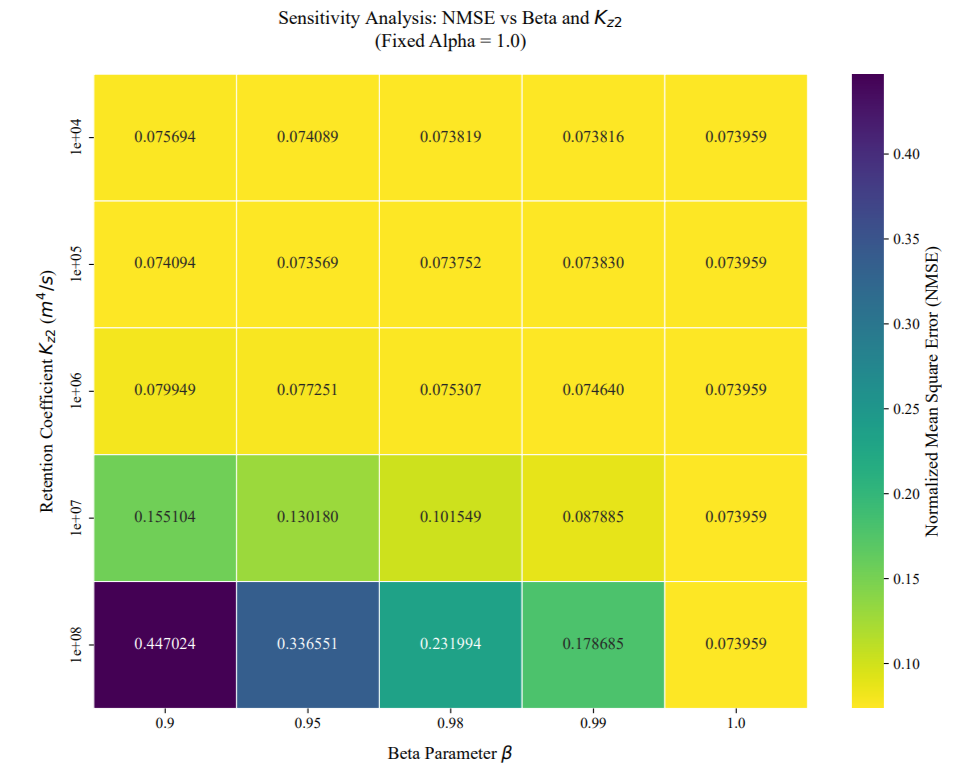
Classical Fickian diffusion theory often fails to capture the complex structure of turbulent dispersion in the Planetary Boundary Layer (PBL), particularly regarding the description of memory effects and plume retention. This work investigates the Bi-flux dispersion theory, which extends the advection-diffusion equation by incorporating a fourth-order derivative term to model non-Fickian transport phenomena. Unlike previous analytical approaches limited to constant coefficients, this study develops a numerical model using a high-order implicit finite difference scheme that incorporates realistic height-dependent profiles for both wind speed and vertical eddy diffusivity. A novel physical parameterization is proposed for the fourth-order retention coefficient, defined as Kz2 ∝ u*|L|3, linking the non-Fickian mechanism to the local atmospheric turbulence scales (friction velocity and Monin-Obukhov length). The model was validated against the Copenhagen Experiment dataset. A sensitivity analysis of the partition parameter β revealed an optimal performance at β=0.99. The results demonstrate that the physically parameterized Bi-flux model significantly outperforms the classical Fickian formulation (β=1.0), achieving a 24.1% reduction in the Normalized Mean Square Error (NMSE) and a 70.4% improvement in the Fractional Standard Deviation (FS). These findings confirm that the inclusion of an atmospheric-scaled fourth-order term effectively preserves the internal variance of the plume, offering a superior predictive capability for pollutant dispersion in unstable boundary layers.
Downloads
References
[1] M. Pantusheva, R. Mitkov, P. O. Hristov, and D. Petrova-Antonova, “Air pollution dispersion modelling in urban environment using CFD: A systematic review,” Atmosphere, vol. 13, no. 10, 2022. Available at: https://doi.org/10.3390/atmos13101640
[2] V. M. Fernández-Pacheco, E. Álvarez Álvarez, E. Blanco-Marigorta, and T. Ackermann, “CFD model to study PM 10 dispersion in large-scale open spaces,” Scientific Reports, vol. 13, no. 1, 2023. Available at: https://doi.org/10.1038/s41598-023-33144-9
[3] R. A. S. Albani and V. V. L. Albani, “Tikhonov-type regularization and the finite element method applied to point source estimation in the atmosphere,” Atmospheric Environment, vol. 211, pp. 69–78, 2019. Available at: https://doi.org/10.1016/j.atmosenv.2019.04.063
[4] D. Moreira, P. Xavier, A. Palmeira, and E. Nascimento, “New approach to solving the atmospheric pollutant dispersion equation using fractional derivatives,” International Journal of Heat and Mass Transfer, vol. 144, 2019. Available at: https://doi.org/10.1016/j.ijheatmasstransfer.2019.118667
[5] A. Palmeira, P. Xavier, and D. Moreira, “Simulation of atmospheric pollutant dispersion considering a bi-flux process and fractional derivatives,” Atmospheric Pollution Research, vol. 11, no. 1, pp. 57–66, 2020. Available at: https://doi.org/10.1016/j.apr.2019.09.015
[6] C. Lin, R. Ooka, H. Jia, A. Parente, and H. Kikumoto, “Eulerian RANS simulation of pollutant dispersion in atmospheric boundary layer considering anisotropic and near-source diffusivity behavior,” Journal of Wind Engineering and Industrial Aerodynamics, vol. 258, 2025. Available at: https://doi.org/10.1016/j.jweia.2025.106036
[7] A. Ulke, “New turbulent parameterization for a dispersion model in the atmospheric boundary layer,” Atmospheric Environment, vol. 34, no. 7, pp. 1029–1042, 2000. Available at: https://doi.org/10.1016/S1352-2310(99)00378-7
[8] J. Xu, M. Jiang, L. Bevilacqua, and A. J. S. Neto, “A meshless generalized finite difference method for a fourth-order anomalous diffusion model,” International Communications in Heat and Mass Transfer, vol. 164, p. 108712, 2025. Available at: https://doi.org/10.1016/j.icheatmasstransfer.2025.108712
[9] D. M. Moreira, “An approach for the atmospheric pollutant dispersion equation considering anomalous diffusion in strongly unstable conditions,” Pure and Applied Geophysics, vol. 179, no. 4, pp. 1433–1443, 2022. Available at: https://doi.org/10.1007/s00024-022-02986-1
[10] L. Bevilacqua, A. C. N. R. Galeão, and F. P. Costa, “A new analytical formulation of retention effects on particle diffusion processes,” Anais da Academia Brasileira de Ciências, vol. 83, no. 4, pp. 1443–1464, 2011. Available at: https://doi.org/10.1590/S0001-37652011005000033
[11] M. Jiang, L. Bevilacqua, A. J. S. Neto, A. C. N. R. Galeão, and J. Zhu, “Bi-flux theory applied to the dispersion of particles in anisotropic substratum,” Applied Mathematical Modelling, vol. 64, pp. 121–134, 2018. Available at: https://doi.org/10.1016/j.apm.2018.07.022
[12] M. Jiang, L. Bevilacqua, J. Zhu, and X. Yu, “Nonlinear Galerkin finite element methods for fourth-order Bi-flux diffusion model with nonlinear reaction term,” Computational and Applied Mathematics, vol. 39, no. 3, p. 143, 2020. Available at: https://doi.org/10.1007/s40314-020-01168-w
[13] L. Bevilacqua and M. Jiang, “Energy exchange in a bi-flux diffusion process consisting of particles of the same nature split into two distinct microstates,” Journal of the Brazilian Society of Mechanical Sciences and Engineering, vol. 43, no. 10, p. 457, 2021. Available at: https://doi.org/10.1007/s40430-021-03145-8
[14] L. Bevilacqua, A. C. N. R. Galeão, and F. P. Costa, “On the significance of higher order differential terms in diffusion processes,” Journal of the Brazilian Society of Mechanical Sciences and Engineering, vol. 33, no. 2, pp. 166–175, 2011. Available at: https://doi.org/10.1590/S1678-58782011000200007
[15] S.-E. Gryning and E. Lyck, “Atmospheric dispersion from elevated sources in an urban area: Comparison between tracer experiments and model calculations,” Journal of Climate and Applied Meteorology, vol. 23, no. 4, pp. 651–660, 1984. Available at: https://doi.org/10.1175/1520-0450(1984)023<0651:ADFESI>2.0.CO;2
[16] S. E. Gryning, A. A. M. Holtslag, J. S. Irwin, and B. Sivertsen, “Applied dispersion modelling based on meteorological scaling parameters,” Atmospheric Environment (1967), vol. 21, no. 1, pp. 79–89, 1 1987. Available at: https://doi.org/10.1016/0004-6981(87)90273-3
[17] S.-E. Gryning and E. Lyck, “The copenhagen tracer experiments: Reporting of measurements,” Tech. Rep., 2002, Risø-R-1054(rev.1)(EN). Available at: https://www.harmo.org/jsirwin/CopenhagenDataReport.pdf
[18] P. Virtanen, R. Gommers, T. E. Oliphant, M. Haberland, T. Reddy, D. Cournapeau, E. Burovski, P. Peterson, W. Weckesser, J. Bright, S. J. van der Walt, M. Brett, J. Wilson, K. J. Millman, N. Mayorov, A. R. J. Nelson, E. Jones, R. Kern, E. Larson, C. J. Carey, İ. Polat, Y. Feng, E. W. Moore, J. VanderPlas, D. Laxalde, J. Perktold, R. Cimrman, I. Henriksen, E. A. Quintero, C. R. Harris, A. M. Archibald, A. H. Ribeiro, F. Pedregosa, P. van Mulbregt, and SciPy 1.0 Contributors, “SciPy 1.0: Fundamental Algorithms for Scientific Computing in Python,” Nature Methods, vol. 17, pp. 261–272, 2020. Available at: https://doi.org/10.1038/s41592-019-0686-2
Downloads
Published
How to Cite
Issue
Section