Parameter Estimation and Strain Energy Model Class Selection for a Hyperelastic Composite Under Compression
DOI:
https://doi.org/10.63595/vetor.v36i1.20864Keywords:
Hyperelastic materials, Strain energy model, Inverse problem, Transitional Markov Chain Monte Carlo (TMCMC)Abstract
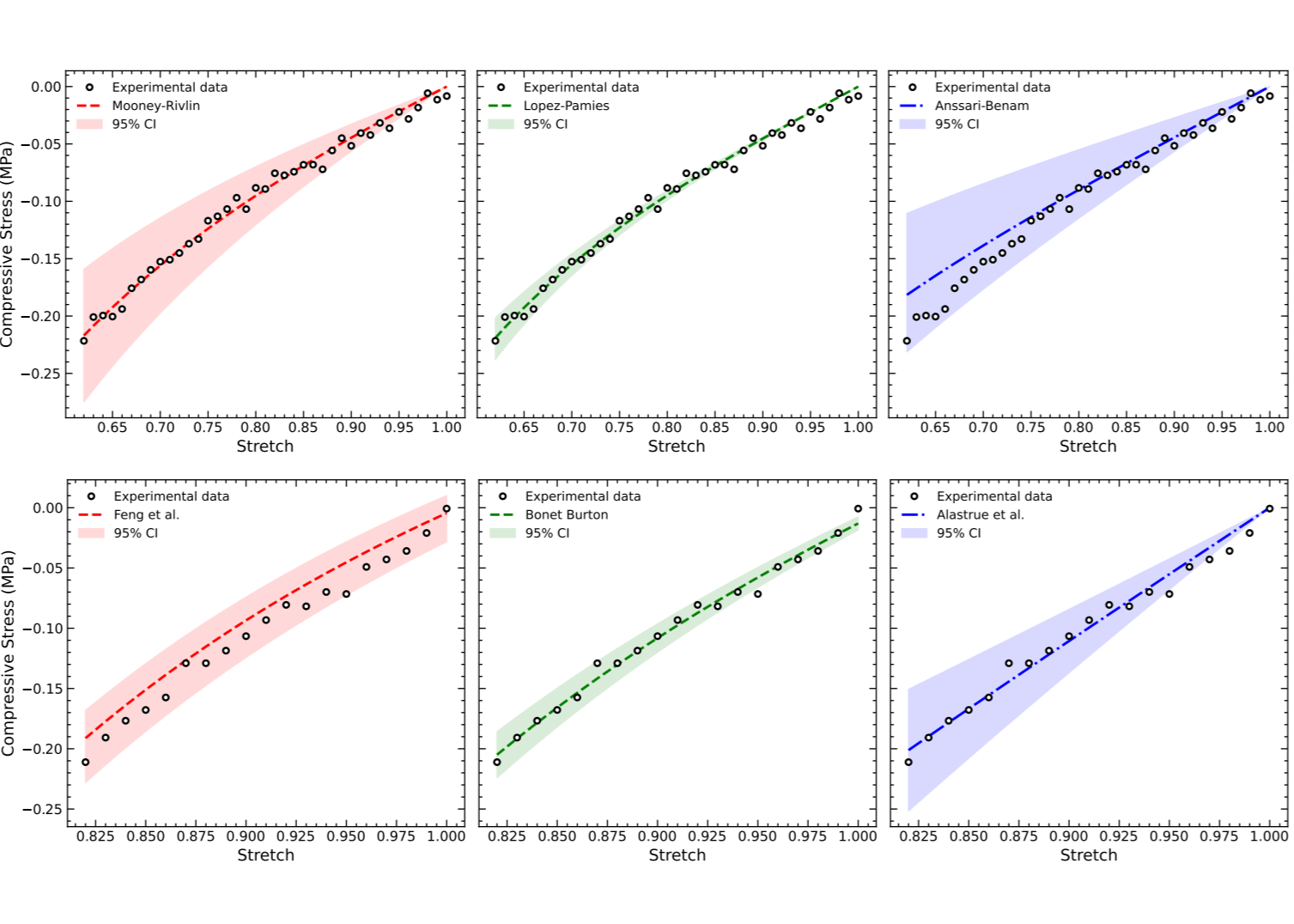
The study of the mechanical behavior of human muscle tissues has received increasing attention due to its relevance in biomechanical and biomedical applications, and is often described by hyperelastic models because of its nonlinear response under mechanical loading. In this context, constitutive modeling requires the definition of an appropriate strain energy density function; however, there is still no universal model capable of satisfactorily representing all classes of soft hyperelastic materials, which makes the use of systematic methodologies for parameter identification and model selection essential. Thus, the present work aims to apply a Bayesian inverse problem approach, through the Transitional Markov Chain Monte Carlo (TMCMC) method, to determine, based on experimental data from uniaxial compression tests carried out on a pure hyperelastic material and on a hyperelastic composite reinforced with unidirectional fibers, which strain energy density models best represent the observed response. The TMCMC method stands out for providing a robust and efficient exploration of posterior distributions, allowing not only the estimation of constitutive parameters, but also the quantification of the uncertainties associated with these parameters and the probabilistic comparison among competing models through Bayesian evidence. The results highlight the importance of using methods that explicitly incorporate experimental and inferential uncertainties, since different models may present similar fits under an exclusively deterministic analysis.
Downloads
References
[1] D. Correa and S. A. Lietman, “Articular cartilage repair: Current needs, methods and research directions,” Seminars in Cell & Developmental Biology, vol. 62, p. 67–77, 2017. Available at: https://doi.org/10.1016/j.semcdb.2016.07.013
[2] S. Cheng and L. E. Bilston, “Unconfined compression of white matter,” Journal of Biomechanics, vol. 40, no. 1, p. 117–124, 2007. Available at: https://doi.org/10.1016/j.jbiomech.2005.11.004
[3] T. Siebert, O. Till, and R. Blickhan, “Work partitioning of transversally loaded muscle: experimentation and simulation,” Computer Methods in Biomechanics and Biomedical Engineering, vol. 17, no. 3, p. 217–229, 2012. Available at: https://doi.org/10.1080/10255842.2012.675056
[4] A. Ansardamavandi, M. Tafazzoli-Shadpour, R. Omidvar, and I. Jahanzad, “Quantification of effects of cancer on elastic properties of breast tissue by atomic force microscopy,” Journal of the Mechanical Behavior of Biomedical Materials, vol. 60, p. 234–242, 2016. Available at: https://doi.org/10.1016/j.jmbbm.2015.12.028
[5] A. Leibinger, A. E. Forte, Z. Tan, M. J. Oldfield, F. Beyrau, D. Dini, and F. Rodriguez y Baena, “Soft tissue phantoms for realistic needle insertion: A comparative study,” in Annals of Biomedical Engineering, vol. 44, no. 8, 2015, p. 2442–2452. Available at: https://doi.org/10.1007/s10439-015-1523-0
[6] C. S. Moreira and L. C. S. Nunes, “Effects of fiber orientation in a soft unidirectional fiber-reinforced material under simple shear deformation,” International Journal of Non-Linear Mechanics, vol. 111, pp. 72–81, 2019. Available at: https://doi.org/10.1016/j.ijnonlinmec.2019.02.001
[7] O. Grimaldo Ruiz, M. Rodriguez Reinoso, E. Ingrassia, F. Vecchio, F. Maniero, V. Burgio, M. Civera, I. Bitan, G. Lacidogna, and C. Surace, “Design and mechanical characterization using digital image correlation of soft tissue-mimicking polymers,” Polymers, vol. 14, no. 13, p. 2639, 2022. Available at: https://doi.org/10.3390/polym14132639
[8] M. Destrade, G. Saccomandi, and I. Sgura, “Methodical fitting for mathematical models of rubber-like materials,” Proceedings of the Royal Society A: Mathematical, Physical and Engineering Science, vol. 473, no. 2198, p. 20160811, 2017. Available at: https://doi.org/10.1098/rspa.2016.0811
[9] R. S. Rivlin, “Large elastic deformations of isotropic materials IV. further developments of the general theory,” Philosophical Transactions of the Royal Society of London, Series A: Mathematical and Physical Sciences, vol. 241, no. 835, pp. 379–397, 1948. Available at: https://doi.org/10.1098/rsta.1948.0024
[10] J. Merodio and R. W. Ogden, “Mechanical response of fiber-reinforced incompressible non-linearly elastic solids,” International Journal of Non-Linear Mechanics, vol. 40, no. 2, pp. 213–227, 2005. Available at: https://doi.org/10.1016/j.ijnonlinmec.2004.05.003
[11] O. Lopez-Pamies, “A new I1-based hyperelastic model for rubber elastic materials,” Comptes Rendus Mécanique, vol. 338, no. 1, pp. 3–11, 2010. Available at: https://doi.org/10.1016/j.crme.2009.12.007
[12] A. Anssari-Benam, “On a new class of non-gaussian molecular-based constitutive models with limiting chain extensibility for incompressible rubber-like materials,” Mathematics and Mechanics of Solids, vol. 26, no. 11, pp. 1660–1674, 2021. Available at: https://doi.org/10.1177/10812865211001094
[13] F. Stumpf, “An accurate and efficient constitutive framework for finite strain viscoelasticity applied to anisotropic soft tissues,” Mechanics of Materials, vol. 161, p. 104007, 2021. Available at: https://doi.org/10.1016/j.mechmat.2021.104007
[14] J. P. Kaipio and C. Fox, “The bayesian framework for inverse problems in heat transfer,” Heat Transfer Engineering, vol. 32, no. 9, pp. 718–753, 2011. Available at: https://doi.org/10.1080/01457632.2011.525137
[15] W. Betz, I. Papaioannou, and D. Straub, “Transitional markov chain monte carlo: observations and improvements,” Journal of Engineering Mechanics, vol. 142, no. 5, p. 04016016, 2016. Available at: https://doi.org/10.1061/(ASCE)EM.1943-7889.0001066
[16] J. Ching and Y.-C. Chen, “Transitional markov chain monte carlo method for bayesian model updating, model class selection, and model averaging,” Journal of Engineering Mechanics, vol. 133, no. 7, pp. 816–832, 2007. Available at: https://doi.org/10.1061/(ASCE)0733-9399(2007)133:7(816)
[17] International Organization for Standardization, “Rubber, vulcanized or thermoplastic — determination of compression stress-strain properties,” 2017, ISO 7743:2017. Available at: https://www.iso.org/standard/72784.html
[18] J. C. A. de Deus Filho, L. C. da Silva Nunes, and J. M. C. Xavier, “iCorrVision-2D: An integrated python-based open-source digital image correlation software for in-plane measurements (part 1),” SoftwareX, vol. 19, p. 101131, 2022. Available at: https://doi.org/10.1016/j.softx.2022.101131
[19] G. A. Holzapfel, “Nonlinear solid mechanics: A continuum approach for engineering.” John Wiley & Sons Ltd, 2000.
[20] C. O. Horgan and J. G. Murphy, “Simple shearing of soft biological tissues,” Proceedings of the Royal Society A: Mathematical, Physical and Engineering Sciences, vol. 467, no. 2127, pp. 760–777, 2010. Available at: https://doi.org/10.1098/rspa.2010.0288
[21] V. Alastrué, E. Peña, M. A. Martínez, and M. Doblaré, “Experimental study and constitutive modelling of the passive mechanical properties of the ovine infrarenal vena cava tissue,” Journal of Biomechanics, vol. 41, no. 14, pp. 3038–3045, 2008. Available at: https://doi.org/10.1016/j.jbiomech.2008.07.008
[22] Y. Feng, R. J. Okamoto, R. Namani, G. M. Genin, and P. V. Bayly, “Measurements of mechanical anisotropy in brain tissue and implications for transversely isotropic material models of white matter,” Journal of the Mechanical Behavior of Biomedical Materials, vol. 23, pp. 117–132, 2013. Available at: https://doi.org/10.1016/j.jmbbm.2013.04.007
[23] J. Bonet and A. J. Burton, “A simple orthotropic, transversely isotropic hyperelastic constitutive equation for large strain computations,” Computer Methods in Applied Mechanics and Engineering, vol. 162, no. 1, pp. 151–164, 1998. Available at: https://doi.org/10.1016/S0045-7825(97)00339-3
[24] J. Ching and J.-S. Wang, “Application of the transitional markov chain monte carlo algorithm to probabilistic site characterization,” Engineering Geology, vol. 203, pp. 151–167, 2016. Available at: https://doi.org/10.1016/j.enggeo.2015.10.015
Downloads
Published
How to Cite
Issue
Section