Influence of the Power Law Exponent on the Generation of Arterial Trees with an Algorithm Based on the CCO Method
DOI:
https://doi.org/10.63595/vetor.v36i1.18334Keywords:
Power Law, Hemodynamics, Arterial Tree, Computational ModelAbstract
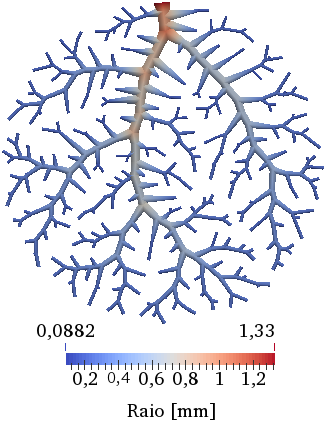
Arterial trees are networks of vessels that transport and distribute nutrients and oxygen throughout the human body, playing an essential role in the circulatory system. Studying these structures is fundamental for understanding the hemodynamics of significant components within the cardiovascular system. Among the approaches to modeling coronary arterial trees, the Constrained Constructive Optimization (CCO) method stands out, as it enables the construction of models based on a specific cost function and a power law that regulates vessel diameters at bifurcations during model growth. This article investigates a new algorithm derived from the CCO, capable of creating models of coronary arterial trees by incorporating a power law that accounts for the number of proximal bifurcations of each vessel. The preliminary 2D models generated by this method successfully replicate morphometric data of real coronary arterial trees.
Downloads
References
[1] M. Gottlieb, “Modelling blood vessels: A deterministic method with fractal structure based on physiological rules,” em [1990] Proceedings of the Twelfth Annual International Conference of the IEEE Engineering in Medicine and Biology Society. IEEE, 1990, pp. 1386–1387. Disponível em: https://doi.org/10.1109/IEMBS.1990.691802
[2] E. Gabrys, M. Rybaczuk, e A. Kedzia, “Blood flow simulation through fractal models of circulatory system,” Chaos, Solitons & Fractals, vol. 27, pp. 1–7, 2006. Disponível em: https://doi.org/10.1016/j.chaos.2005.02.009
[3] R. E. Mates, F. J. Klocke, e J. M. C. Jr, “Coronary capacitance,” Progress in Cardiovascular Diseases, vol. XXXI, no. 1, pp. 148–149, 1988. Disponível em: https://doi.org/10.1016/0033-0620(88)90008-4
[4] S. M. Watanabe, P. J. Blanco, e R. A. Feijóo, “Mathematical model of blood flow in anatomically detailed arterial network of the arm,” ESAIM: Mathematical Modelling and Numerical Analysis, pp. 19–38, 2012. Disponível em: https://doi.org/10.1051/m2an/2012053
[5] R. A. B. Queiroz, “Construção automática de modelos de árvores circulatórias e suas aplicações em hemodinâmica computacional,” Tese de doutorado, Laboratório Nacional de Computação Científica, Petrópolis, RJ, Brasil, 2013. Disponível em: https://tede.lncc.br/handle/tede/170
[6] R. Karch, F. Neumann, M. Neumann, e W. Schreiner, “A tree-dimensional model for arterial tree representation, generated by constrained constructive optimization,” Computers in Biology and Medicine, vol. 29, no. 21-22, pp. 19–38, 1999. Disponível em: https://doi.org/10.1016/S0010-4825(98)00045-6
[7] C. Jaquet, L. Najman, H. Talbot, L. Grady, M. Schaap, B. Spain, H. J. Kim, I. Vignon-Clementel, e T. C. A., “Generation of patient-specific cardiac vascular networks: A hybrid image-based and synthetic geometric model,” IEEE Transactions on Biomedical Engineering, vol. 4, no. 66, pp. 946–955, 2019. Disponível em: https://doi.org/10.1109/TBME.2018.2865667
[8] P. F. B. Anjos, “Um algoritmo baseado em otimização para construção de modelos de árvores arteriais com nexo em hemodinâmica computacional,” Tese de doutorado, Programa de Pós-Graduação em Modelagem Computacional, Universidade Federal de Juiz de Fora, Juiz de Fora, Brasil, 2021. Disponível em: https://repositorio.ufjf.br/jspui/handle/ufjf/13143
[9] L. C. M. Aquino, “Desenvolvimento de algoritmos para construção automática de florestas de árvores arteriais,” Tese de doutorado, Programa de Pós-Graduação em Modelagem Computacional, Universidade Federal de Juiz de Fora, Juiz de Fora, Brasil, 2022. Disponível em: https://repositorio.ufjf.br/jspui/handle/ufjf/15251
[10] W. Schreiner, M. Neumann, F. Neumann, S. M. Roedler, A. End, P. Buxbaum, M. R. Muller, e P. Spieckermann, “The branching angles in computer-generated optimized models of arterial trees,” The Journal of General Physiology, vol. 103, pp. 975–989, 1994. Disponível em: https://doi.org/10.1085/jgp.103.6.975
[11] P. J. Hunter, P. M. F. Smail, B. H.and Nielsen, e I. J. Le Grice, A mathematical model of cardiac anatomy, 1a ed. John Wiley & Sons, 1997, pp. 171–215.
[12] M. Zamir e H. Chee, “Segment analysis of human coronary arteries,” Blood Vessels, vol. 24, pp. 76–84, 1987. Disponível em: https://doi.org/10.1159/000158673
[13] M. Zamir, “Distributing and delivering vessels of the human heart,” Journal of General Physiology, vol. 91, pp. 725–735, 1988. Disponível em: https://doi.org/10.1085/jgp.91.5.725
[14] J. T. Arts, T. I. Kruger, J. A. C. Lambregts, W. v. Gerven, e R. S. Reneman, “Propagation velocity and reflection of pressure waves in the canine coronary artery,” American Journal of Physiology, vol. 237, pp. H469–H474, 1979. Disponível em: https://doi.org/10.1152/ajpheart.1979.237.4.H469
[15] H. N. Mayrovitz e J. Roy, “Microvascular blood flow: evidence indicating a cubic dependence on arteriolar diameter,” American Journal of Physiology, vol. 245, pp. H1031–H1038, 1983. Disponível em: https://doi.org/10.1152/ajpheart.1983.245.6.H1031
[16] T. F. Sherman, “On connecting large vessels to small: the meaning of Murray’s law.” The Journal of General Physiology, no. 78, pp. 431–453, 1981. Disponível em: https://doi.org/10.1085/jgp.78.4.431
[17] Y. C. Fung, Biomechanics: Circulation. Springer-Verlag, 1997.
[18] W. Schreiner, “Computer generation of complex arterial tree models,” Journal of Biomedical Engineering, vol. 15, pp. 148–149, 1993. Disponível em: https://doi.org/10.1016/0141-5425(93)90046-2
Downloads
Published
How to Cite
Issue
Section