MULTIPLE CROSS-CORRELATION IN METEOROLOGICAL DATA IN THE CITY OF SALVADOR, BAHIA, BRAZIL
DOI:
https://doi.org/10.63595/vetor.v35i2.18202Keywords:
coefficients, modeling, variablesAbstract
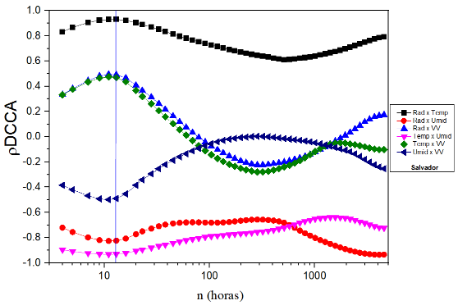
The importance of analyzing meteorological variables stems from the fact that these elements affect the environment as a whole. With this in mind, this study aims to carry out a cross-correlation analysis of meteorological data in order to diagnose its direct and indirect effects in the city of Salvador, Bahia, Brazil. The methodology used meteorological data from the National Meteorological Institute and the cross-correlation coefficient and multiple crosscorrelation coefficient methods. In the cross-correlation coefficient analysis, solar radiation x air temperature had a strong condition, solar radiation x relative humidity also had a strong condition, while solar radiation x wind speed had a medium condition. The result of the multiple cross-correlation, i.e. the variables air temperature, relative humidity and wind speed, were correlated with solar radiation, obtaining a very strong condition between them (0.88). Studying correlations in meteorological data is fundamental to improving weather forecasting and anticipating adverse conditions, helping to understand climate change by revealing long-term patterns and trends, which is crucial for developing mitigation and adaptation strategies.
Downloads
References
[1] D. Guha-Sapir, P. Hoyois, e R. Below, “Annual disaster statistical review 2014: The numbers and trends,” 2014. Disponível em: https://www.cred.be/sites/default/files/ADSR_2014.pdf
[2] F. T. Silva e C. E. Alvarez, “A correlação entre variáveis climáticas em diferentes configurações urbanas,” em Proceedings of EURO ELECS 2015, Guimarães, Portugal, 2015.
[3] C. Frohlich, “Solar irradiance variability since 1978,” Space Science Reviews, vol. 125, pp. 53–56, 1998. Disponível em: https://doi.org/10.1007/978-0-387-48341-2_5
[4] N. K. Solanki e S. K. Haigh, “Solar irradiance variability and climate,” Annual Review of Astronomy and Astrophysics, vol. 51, pp. 311-351, 2013. Disponível em: https://doi.org/10.1146/annurev-astro-082812-141007
[5] T. Lucas, D. Plec, L. Abreu, e M. Parizzi, “Identificação de interpoladores adequados a dados de chuva a partir de parâmetros estatísticos,” Revista Brasileira de Climatologia, vol. 13, pp. 7–21, 2013. Disponível em: https://doi.org/10.5380/abclima.v13i0.31259
[6] W. Ricce, S. Carvalho, P. Caramori, e S. Roberto, “Zoneamento agroclimático da cultura da videira no estado do Paraná,” SEMINA: Ciências Agrárias, vol. 35, no. 45, pp. 2327–2336, 2014. Disponível em: https://doi.org/10.5433/1679-0359.2014v35n4Suplp2327
[7] M. Herrmann, Atlas de Desastres Naturais do Estado de Santa Catarina, 1a Edição, Florianópolis, Brasil: Secretaria de Estado da Segurança Pública e Defesa do Cidadão, 2006. Disponível em: http://www.ceped.ufsc.br/wp-content/uploads/2006/01/Atlas_Ceped.pdf
[8] Instituto Nacional de Meteorologia (INMET). Disponível em: https://portal.inmet.gov.br/
[9] A. I. Filho, P. F. Borges, L. S. Araujo, A. R. Pereira, E. M. Lima, L. S. Silva, e C. V. S. Junior, “Influência das variáveis climáticas sobre a evapotranspiração,” Gaia Scientia, vol. 9, no. 1, pp. 62-63, 2015.
[10] Conder - Companhia de Desenvolvimento Urbano da Bahia, Painel de informações: dados socioeconômicos do município de Salvador por bairros e prefeituras-bairro /Sistema de Informações Geográficas Urbanas do Estado da Bahia, Salvador, Brasil: CONDER/INFORMS, 2016.
[11] Salvador (Município), Lei N° 9.278/2017 de 21 de setembro de 2017. Dispõe sobre a delimitação e denominação dos bairros do Município de Salvador, Capital do Estado da Bahia, na forma que indica, e dá outras providências, 2017.
[12] G. F. Zebende, “DCCA cross-correlation coefficient: Quantifying level of cross-correlation,” Physica A, vol. 390, no. 4, pp. 614–618, 2011. Disponível em: https://doi.org/10.1016/j.physa.2010.10.022
[14] G. F. Zebende e A. M. Silva Filho, “Detrended multiple cross-correlation coefficient,” Physica A: Statistical Mechanics and its Applications, vol. 510, pp. 91–97, 2018. Disponível em: https://doi.org/10.1016/j.physa.2018.06.119
[15] D. C. Galvão, “A estrutura e o clima da urbe: uma relação sistêmica,” Humanae, vol. 8, no. 2, 2014. [Online]. Disponível em: https://revistas.esuda.edu.br/index.php/humanae/article/view/124
[16] R. Zimmermann e S. M. Schons, “Aquecimento global e impacto nas águas,” Revista Filosofazer, vol. 28, no. 34, pp. 83-106, 2009. Disponível em: http://filosofazer.ifibe.edu.br/index.php/filosofazerimpressa/article/viewFile/149/146
[17] D. H. Rached, “Interfaces entre o regime internacional de mudança climática e a saúde global,” Lua Nova, vol. 98, pp. 231-254, 2016. Disponível em: https://doi.org/10.1590/0102-6445231-254/98
Downloads
Published
How to Cite
Issue
Section