Estimativa de Parâmetros e Seleção de Classe de Modelos de Energia de Deformação em um Compósito Hiperelástico Submetido a Compressão
DOI:
https://doi.org/10.63595/vetor.v36i1.20864Palavras-chave:
Materiais hiperelásticos, Modelo de energia de deformação, Problema inverso, Transitional Markov Chain Monte Carlo (TMCMC)Resumo
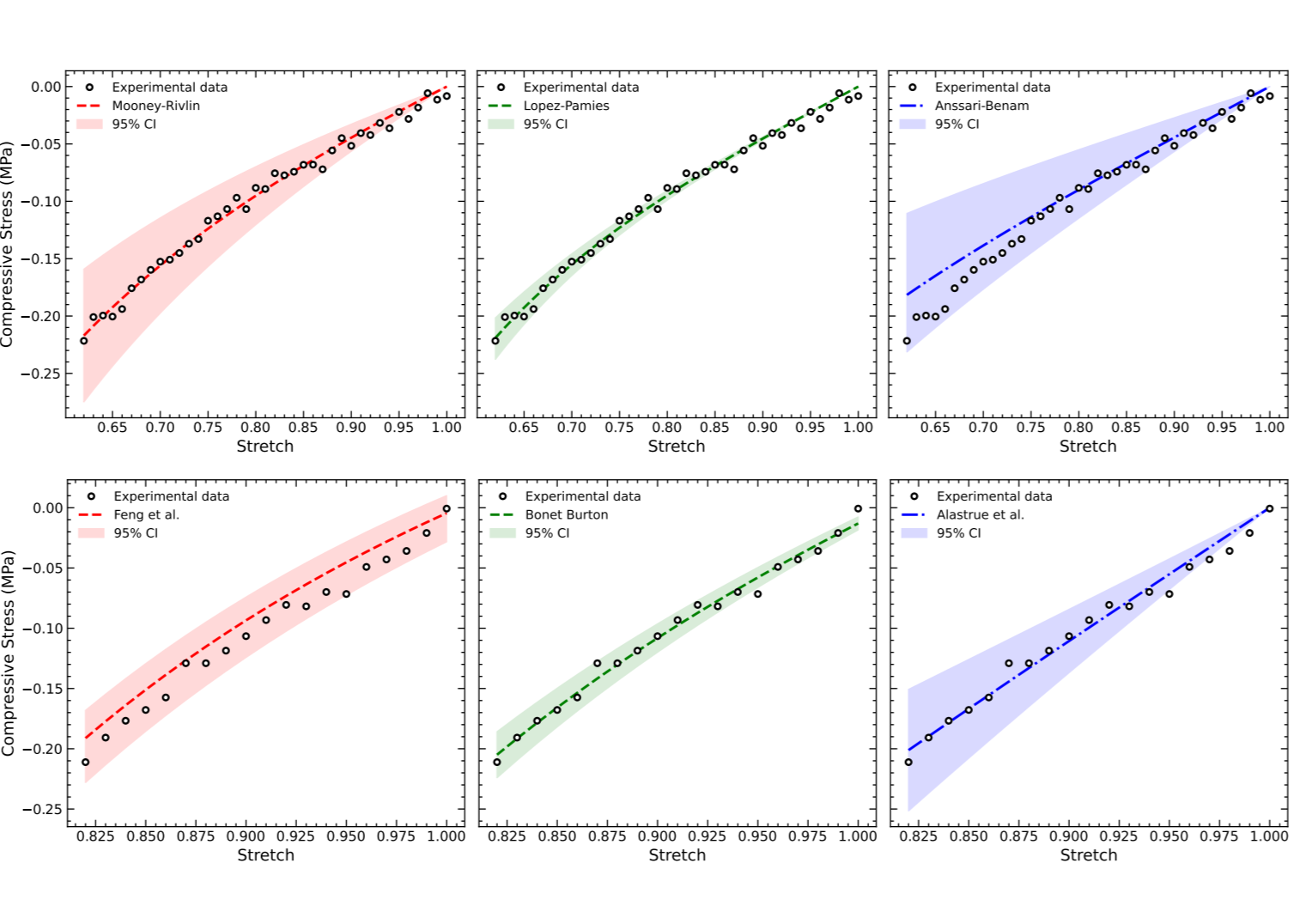
O estudo do comportamento mecânico de tecidos musculares humanos tem recebido crescente atenção devido à sua relevância em aplicações biomecânicas e biomédicas, sendo frequentemente descrito por modelos hiperelásticos em razão de sua resposta não linear sob carregamentos mecânicos. Nesse contexto, a modelagem constitutiva requer a definição de uma função de energia de deformação apropriada; entretanto, ainda não existe um modelo universal capaz de representar satisfatoriamente todas as classes de materiais hiperelásticos macios, o que torna fundamental o uso de metodologias sistemáticas para identificação paramétrica e seleção de modelos. Assim, este trabalho tem como objetivo aplicar uma abordagem Bayesiana de solução de problemas inversos, por meio do método Transitional Markov Chain Monte Carlo (TMCMC), para determinar, com base em dados experimentais de ensaios de compressão uniaxial realizados em um material hiperelástico puro e em um compósito hiperelástico reforçado por fibras unidirecionais, quais modelos de energia de deformação melhor representam a resposta observada. O método TMCMC destaca-se por promover uma exploração robusta e eficiente das distribuições posteriores, permitindo não apenas a estimação dos parâmetros constitutivos, mas também a quantificação das incertezas associadas a esses parâmetros e a comparação probabilística entre modelos concorrentes por meio da evidência Bayesiana. Os resultados evidenciam a importância do uso de métodos que incorporam explicitamente as incertezas experimentais e inferenciais, uma vez que diferentes modelos podem apresentar ajustes semelhantes sob uma análise exclusivamente determinística.
Downloads
Referências
[1] D. Correa and S. A. Lietman, “Articular cartilage repair: Current needs, methods and research directions,” Seminars in Cell & Developmental Biology, vol. 62, p. 67–77, 2017. Available at: https://doi.org/10.1016/j.semcdb.2016.07.013
[2] S. Cheng and L. E. Bilston, “Unconfined compression of white matter,” Journal of Biomechanics, vol. 40, no. 1, p. 117–124, 2007. Available at: https://doi.org/10.1016/j.jbiomech.2005.11.004
[3] T. Siebert, O. Till, and R. Blickhan, “Work partitioning of transversally loaded muscle: experimentation and simulation,” Computer Methods in Biomechanics and Biomedical Engineering, vol. 17, no. 3, p. 217–229, 2012. Available at: https://doi.org/10.1080/10255842.2012.675056
[4] A. Ansardamavandi, M. Tafazzoli-Shadpour, R. Omidvar, and I. Jahanzad, “Quantification of effects of cancer on elastic properties of breast tissue by atomic force microscopy,” Journal of the Mechanical Behavior of Biomedical Materials, vol. 60, p. 234–242, 2016. Available at: https://doi.org/10.1016/j.jmbbm.2015.12.028
[5] A. Leibinger, A. E. Forte, Z. Tan, M. J. Oldfield, F. Beyrau, D. Dini, and F. Rodriguez y Baena, “Soft tissue phantoms for realistic needle insertion: A comparative study,” in Annals of Biomedical Engineering, vol. 44, no. 8, 2015, p. 2442–2452. Available at: https://doi.org/10.1007/s10439-015-1523-0
[6] C. S. Moreira and L. C. S. Nunes, “Effects of fiber orientation in a soft unidirectional fiber-reinforced material under simple shear deformation,” International Journal of Non-Linear Mechanics, vol. 111, pp. 72–81, 2019. Available at: https://doi.org/10.1016/j.ijnonlinmec.2019.02.001
[7] O. Grimaldo Ruiz, M. Rodriguez Reinoso, E. Ingrassia, F. Vecchio, F. Maniero, V. Burgio, M. Civera, I. Bitan, G. Lacidogna, and C. Surace, “Design and mechanical characterization using digital image correlation of soft tissue-mimicking polymers,” Polymers, vol. 14, no. 13, p. 2639, 2022. Available at: https://doi.org/10.3390/polym14132639
[8] M. Destrade, G. Saccomandi, and I. Sgura, “Methodical fitting for mathematical models of rubber-like materials,” Proceedings of the Royal Society A: Mathematical, Physical and Engineering Science, vol. 473, no. 2198, p. 20160811, 2017. Available at: https://doi.org/10.1098/rspa.2016.0811
[9] R. S. Rivlin, “Large elastic deformations of isotropic materials IV. further developments of the general theory,” Philosophical Transactions of the Royal Society of London, Series A: Mathematical and Physical Sciences, vol. 241, no. 835, pp. 379–397, 1948. Available at: https://doi.org/10.1098/rsta.1948.0024
[10] J. Merodio and R. W. Ogden, “Mechanical response of fiber-reinforced incompressible non-linearly elastic solids,” International Journal of Non-Linear Mechanics, vol. 40, no. 2, pp. 213–227, 2005. Available at: https://doi.org/10.1016/j.ijnonlinmec.2004.05.003
[11] O. Lopez-Pamies, “A new I1-based hyperelastic model for rubber elastic materials,” Comptes Rendus Mécanique, vol. 338, no. 1, pp. 3–11, 2010. Available at: https://doi.org/10.1016/j.crme.2009.12.007
[12] A. Anssari-Benam, “On a new class of non-gaussian molecular-based constitutive models with limiting chain extensibility for incompressible rubber-like materials,” Mathematics and Mechanics of Solids, vol. 26, no. 11, pp. 1660–1674, 2021. Available at: https://doi.org/10.1177/10812865211001094
[13] F. Stumpf, “An accurate and efficient constitutive framework for finite strain viscoelasticity applied to anisotropic soft tissues,” Mechanics of Materials, vol. 161, p. 104007, 2021. Available at: https://doi.org/10.1016/j.mechmat.2021.104007
[14] J. P. Kaipio and C. Fox, “The bayesian framework for inverse problems in heat transfer,” Heat Transfer Engineering, vol. 32, no. 9, pp. 718–753, 2011. Available at: https://doi.org/10.1080/01457632.2011.525137
[15] W. Betz, I. Papaioannou, and D. Straub, “Transitional markov chain monte carlo: observations and improvements,” Journal of Engineering Mechanics, vol. 142, no. 5, p. 04016016, 2016. Available at: https://doi.org/10.1061/(ASCE)EM.1943-7889.0001066
[16] J. Ching and Y.-C. Chen, “Transitional markov chain monte carlo method for bayesian model updating, model class selection, and model averaging,” Journal of Engineering Mechanics, vol. 133, no. 7, pp. 816–832, 2007. Available at: https://doi.org/10.1061/(ASCE)0733-9399(2007)133:7(816)
[17] International Organization for Standardization, “Rubber, vulcanized or thermoplastic — determination of compression stress-strain properties,” 2017, ISO 7743:2017. Available at: https://www.iso.org/standard/72784.html
[18] J. C. A. de Deus Filho, L. C. da Silva Nunes, and J. M. C. Xavier, “iCorrVision-2D: An integrated python-based open-source digital image correlation software for in-plane measurements (part 1),” SoftwareX, vol. 19, p. 101131, 2022. Available at: https://doi.org/10.1016/j.softx.2022.101131
[19] G. A. Holzapfel, “Nonlinear solid mechanics: A continuum approach for engineering.” John Wiley & Sons Ltd, 2000.
[20] C. O. Horgan and J. G. Murphy, “Simple shearing of soft biological tissues,” Proceedings of the Royal Society A: Mathematical, Physical and Engineering Sciences, vol. 467, no. 2127, pp. 760–777, 2010. Available at: https://doi.org/10.1098/rspa.2010.0288
[21] V. Alastrué, E. Peña, M. A. Martínez, and M. Doblaré, “Experimental study and constitutive modelling of the passive mechanical properties of the ovine infrarenal vena cava tissue,” Journal of Biomechanics, vol. 41, no. 14, pp. 3038–3045, 2008. Available at: https://doi.org/10.1016/j.jbiomech.2008.07.008
[22] Y. Feng, R. J. Okamoto, R. Namani, G. M. Genin, and P. V. Bayly, “Measurements of mechanical anisotropy in brain tissue and implications for transversely isotropic material models of white matter,” Journal of the Mechanical Behavior of Biomedical Materials, vol. 23, pp. 117–132, 2013. Available at: https://doi.org/10.1016/j.jmbbm.2013.04.007
[23] J. Bonet and A. J. Burton, “A simple orthotropic, transversely isotropic hyperelastic constitutive equation for large strain computations,” Computer Methods in Applied Mechanics and Engineering, vol. 162, no. 1, pp. 151–164, 1998. Available at: https://doi.org/10.1016/S0045-7825(97)00339-3
[24] J. Ching and J.-S. Wang, “Application of the transitional markov chain monte carlo algorithm to probabilistic site characterization,” Engineering Geology, vol. 203, pp. 151–167, 2016. Available at: https://doi.org/10.1016/j.enggeo.2015.10.015
Downloads
Publicado
Como Citar
Edição
Seção