Otimização Multiobjetiva de um Integrador Numérico Adaptativo Utilizando o Optuna
DOI:
https://doi.org/10.63595/vetor.v36i1.21070Palavras-chave:
Otimização Multiobjetiva, Integração Temporal Adaptativa, Métodos de Runge–Kutta, Optuna, Simulação NuméricaResumo
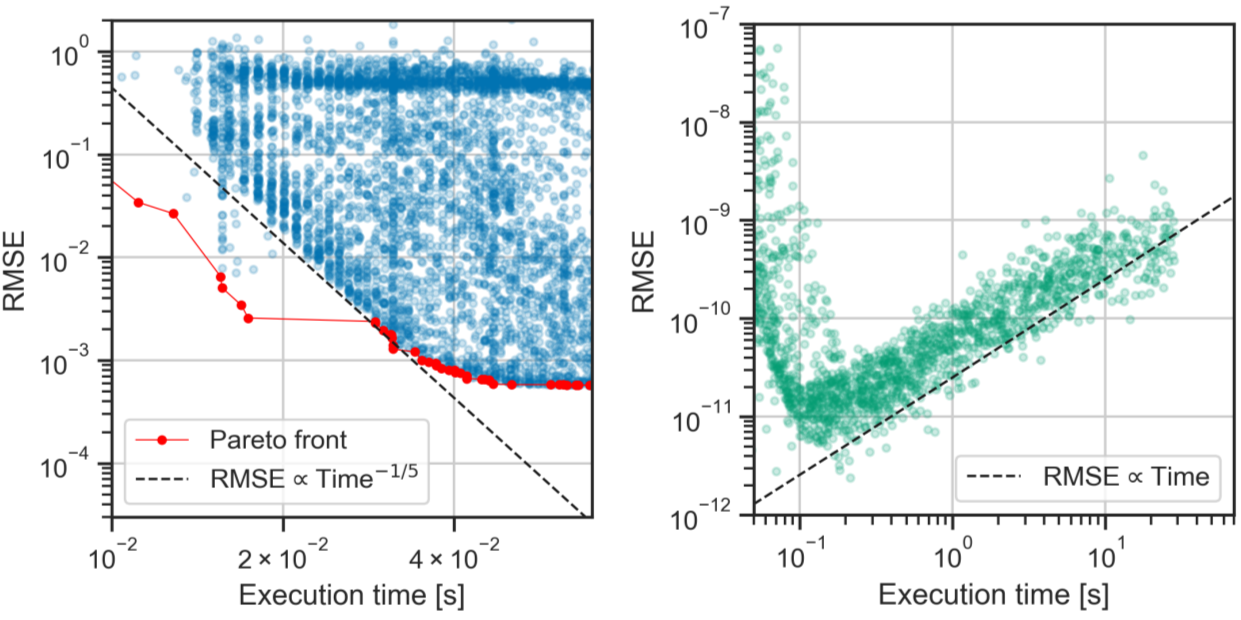
A integração numérica de equações diferenciais ordinárias é um dos problemas mais comuns em análise numérica. Diversos métodos e técnicas estão disponíveis na literatura, assim como diferentes combinações de heurísticas e parâmetros. Portanto, escolhas adequadas devem ser feitas para minimizar tanto o erro numérico quanto o tempo computacional. Neste trabalho, o Optuna foi empregado como um framework de otimização multiobjetivo para buscar os parâmetros de um integrador temporal adaptativo Runge–Kutta de quarta e quinta ordem (RK45) em três casos de teste selecionados. Em seguida, uma metodologia de análise da fronteira de Pareto baseada em métricas geométricas simples foi desenvolvida usando uma abordagem semelhante a um sistema especialista. Essa metodologia usa o conjunto Pareto-ótimo obtido com o Optuna para selecionar configurações de parâmetros que equilibram efetivamente o erro numérico e o tempo de execução da simulação. Ela também foi testada com quatro funções objetivo de referência para avaliar suas capacidades, fornecendo uma forma direta de selecionar parâmetros que equilibram erro e tempo de execução. O Optuna mostrou-se uma ferramenta efetiva para prototipar metodologias baseadas em otimização, demonstrando seu potencial ainda pouco explorado em tarefas além do aprendizado de máquina.
Downloads
Referências
[1] W. H. Press, S. A. Teukolsky,W. T. Vetterling, and B. P. Flannery, Numerical Recipes in C, 2nd ed. Cambridge, UK: Cambridge University Press, 2002. Available at: https://s3.amazonaws.com/nrbook.com/book_C210.html
[2] E. Hairer, S. P. Nørsett, and G. Wanner, Solving Ordinary Differential Equations I: Nonstiff Problems, 2nd ed. Springer Berlin, Heidelberg, 1993. Available at: https://doi.org/10.1007/978-3-540-78862-1
[3] L. F. Shampine and M. W. Reichelt, “The MATLAB ODE suite,” SIAM Journal on Scientific Computing, vol. 18, no. 1, pp. 1–22, 1997. Available at: https://doi.org/10.1137/S1064827594276424
[4] T. Akiba, S. Sano, T. Yanase, T. Ohta, and M. Koyama, “Optuna: A next-generation hyperparameter optimization framework,” arXiv, Computer Science, Machine Learning, 2019. Available at: https://doi.org/10.48550/arXiv.1907.10902
[5] Optuna, “Optuna: A hyperparameter optimization framework,” GitHub, 2025. Available at: https://github.com/optuna/optuna
[6] T. Akiba, S. Sano, T. Yanase, T. Ohta, and M. Koyama, “Optuna: A next-generation hyperparameter optimization framework,” in Proceedings of the 25th ACM SIGKDD International Conference on Knowledge Discovery & Data Mining. Anchorage, USA: Association for Computing Machinery, 2019, pp. 2623–2631. Available at: https://doi.org/10.1145/3292500.3330701
[7] Optuna Contributors, “Optuna: A hyperparameter optimization framework,” Optuna Documentation, 2018. Available at: https://optuna.readthedocs.io/en/stable/index.html
[8] P. P. B. Araújo, R. Y. Tanaka, C. A. Silva, A. Passaro, and P. G. P. Toro, “Multi-objective optimization of a hypersonic airbreathing vehicle,” Physics of Fluids, vol. 36, no. 2, p. 026120, 2024. Available at: https://doi.org/10.1063/5.0181366
[9] P. P. B. Araújo, M. V. S. Pereira, G. S. Marinho, J. F. A. Martos, and P. G. P. Toro, “Optimization of scramjet inlet based on temperature and mach number of supersonic combustion,” Aerospace Science and Technology, vol. 116, p. 106864. Available at: https://doi.org/10.1016/j.ast.2021.106864
[10] J.-W. Wang and H.-N. Wu, “Exponentially stabilizing fuzzy controller design for a nonlinear ODE-beam cascaded system and its application to flexible air-breathing hypersonic vehicle,” Fuzzy Sets and Systems, vol. 385, pp. 127–147, 2020. Available at: https://doi.org/10.1016/j.fss.2019.02.023
[11] R. C. Aster, B. Borchers, and C. H. Thurber, Parameter Estimation and Inverse Problems, 3rd ed. Elsevier, 2018. Available at: https://doi.org/10.1016/C2015-0-02458-3
[12] A. Raue, C. Kreutz, T. Maiwald, J. Bachmann, M. Schilling, U. Klingmüller, and J. Timmer, “Lessons learned from quantitative dynamical modeling in systems biology,” PLoS ONE, vol. 8, no. 9, p. e74335, 2013. Available at: https://doi.org/10.1371/journal.pone.0074335
[13] J. R. Cash and A. H. Karp, “A variable order Runge-Kutta method for initial value problems with rapidly varying right-hand sides,” ACM Transactions on Mathematical Software, vol. 16, no. 3, pp. 201–222, 1990. Available at: https://doi.org/10.1145/79505.79507
[14] J. R. Dormand and P. J. Prince, “A family of embedded Runge-Kutta formulae,” Journal of Computational and Applied Mathematics, vol. 6, no. 1, pp. 19–26, 1980. Available at: https://doi.org/10.1016/0771-050X(80)90013-3
[15] E. Zitzler, K. Deb, and L. Thiele, “Comparison of multiobjective evolutionary algorithms: Empirical results,” Evolutionary Computation, vol. 8, no. 2, pp. 173–195, 2000. Available at: https://doi.org/10.1162/106365600568202
[16] G. Yu, Y. Jin, and M. Olhofer, “Benchmark problems and performance indicators for search of knee points in multiobjective optimization,” IEEE Transactions on Cybernetics, vol. 50, no. 8, pp. 3531–3544, 2020. Available at: https://doi.org/10.1109/TCYB.2019.2894664
[17] K. Deb, Multi-Objective Optimization Using Evolutionary Algorithms. John Wiley & Sons, 2001.
[18] N. Gunantara, “A review of multi-objective optimization: Methods and its applications,” Cogent Engineering, vol. 5, no. 1, p. 1502242, 2018. Available at: https://doi.org/10.1080/23311916.2018.1502242
[19] I. Das and J. E. Dennis, “Normal-boundary intersection: A new method for generating the Pareto surface in nonlinear multicriteria optimization problems,” SIAM Journal on Optimization, vol. 8, no. 3, pp. 631–657, 1998. Available at: https://doi.org/10.1137/S1052623496307510
[20] S. S. Rao, Mechanical Vibrations, 5th ed. Upper Saddle River, USA: Prentice-Hall, 2011.
[21] C. W. Gear, Numerical Initial Value Problems in Ordinary Differential Equations. Hoboken, USA: Prentice Hall, 1971.
[22] D. B. Meade, “ODE models for the parachute problem,” SIAM Review, vol. 40, no. 2, pp. 327–332, 1998. Available at: https://doi.org/10.1137/S0036144596316248
[23] K.-L. Du and M. N. S. Swamy, Search and Optimization by Metaheuristics: Techniques and Algorithms Inspired by Nature. Birkhäuser Cham, 2016. Available at: https://doi.org/10.1007/978-3-319-41192-7
[24] E.-G. Talbi, Metaheuristics: From Design to Implementation. John Wiley & Sons, 2009. Available at: https://doi.org/10.1002/9780470496916
[25] Q. Liu, X. Li, H. Liu, and Z. Guo, “Multi-objective metaheuristics for discrete optimization problems: A review of the state-of-the-art,” Applied Soft Computing, vol. 93, p. 106382, 2020. Available at: https://doi.org/10.1016/j.asoc.2020.106382
[26] X.-S. Yang, Artificial Intelligence, Evolutionary Computing and Metaheuristics: In the Footsteps of Alan Turing, 1st ed. Springer Berlin, Heidelberg, 2013. Available at: https://doi.org/10.1007/978-3-642-29694-9
[27] S. Watanabe, “Tree-structured parzen estimator: Understanding its algorithm components and their roles for better empirical performance,” arXiv, Computer Science, Machine Learning, 2023. Available at: https://doi.org/10.48550/arXiv.2304.11127
[28] F. Rudzinski, “Finding sets of non-dominated solutions with high spread and well-balanced distribution using generalized strength pareto evolutionary algorithm,” in Proceedings of the 2015 Conference of the International Fuzzy Systems Association and the European Society for Fuzzy Logic and Technology, Gijón, Spain, 2015, pp. 178–185. Available at: https://doi.org/10.2991/ifsa-eusflat-15.2015.28
[29] A. Osyczka and S. Kundu, “A new method to solve generalized multicriteria optimization problems using the simple genetic algorithm,” Structural optimization, vol. 10, no. 2, pp. 94–99, 1995. Available at: https://doi.org/10.1007/BF01743536
[30] Z. Guo, Z. Zhou, L. Song, J. Li, and Z. Feng, “Aerodynamic analysis and multi-objective optimization design of a high pressure ratio centrifugal impeller,” in ASME Turbo Expo 2014: Turbine Technical Conference and Exposition, Düsseldorf, Germany, 2014, p. V02DT42A013. Available at: https://doi.org/10.1115/GT2014-25496
[31] F. Jimenez, A. Gomez-Skarmeta, G. Sanchez, and K. Deb, “An evolutionary algorithm for constrained multi-objective optimization,” in Proceedings of the 2002 Congress on Evolutionary Computation. CEC’02 (Cat. No.02TH8600), vol. 2, Honolulu, USA, 2002, pp. 1133–1138. Available at: https://doi.org/10.1109/CEC.2002.1004402
[32] T. T. Binh and U. Korn, “MOBES: A multiobjective evolution strategy for constrained optimization problems,” in The third international conference on genetic algorithms (Mendel 97), vol. 25, Brno, Czech Republic, 1997.
Downloads
Publicado
Como Citar
Edição
Seção